


Microsoft Graph Cloud Communications APIs
The Cloud Microsoft Graph 's Communications APIs add a new dimension to how your applications and services interact with users through various communication-related features, such as calls and online meetings. Grow your business by responding more quickly to your customers' needs and enhancing the way your employees collaborate with one another.
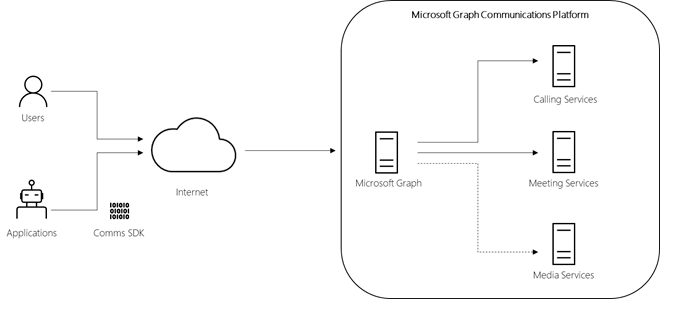
Some practical cases...
Handling incoming calls
Your users may become overwhelmed if they receive a large number of business calls, and it is neither possible nor productive to answer all of them. A bot can serve as a front-end assistant and handle these calls by filtering out what appear to be spam calls and redirecting (transferring) specific calls to another number.
Simplifying the customer service experience
Whether you run a large help desk or a small shop, it can be difficult to handle multiple customer requests, especially if you have no context about the problem they are trying to solve in advance. Manage incoming customer calls through an interactive voice response (IVR) system, where a bot initially interacts with them.
When a customer is prompted to enter a response from the bot, the customer can press a key on their keyboard corresponding to their selection. The bot can then collect the dual-tone multi-frequency (DTMF) dialing from the customer.
To create a more intelligent interaction between your customers and your robot, when a customer is prompted to enter an answer, they will be able to speak directly about what they need help with.
Integration with a natural language processing service means that the customer's words can be analyzed to determine their feelings. The bot can then respond to the customer's needs accordingly.
For more practical examples of the Cloud Communications APIs, please visit this link
Platform capabilities
Here are the main capabilities of the platform that Microsoft has made available as part of version 1.
Call
You can create integrated solutions:
- Peer-to-peer (P2P) or 1-on-1 Calls—A configuration in which your application interacts directly with a Microsoft Teams user; for example, a helpdesk or a customer service representative answering simple questions.
- Group calls - A configuration in which your application interacts with two or more users (with at least one user using Teams); for example, a contact center bot routing calls to agents using Teams.
Two types of media choices are available for these calls:
- Application-hosted media – This is also a local media type. Using the multimedia SDK, a raw media stream (audio or video) from a P2P or group call is available to the application for real-time and post-call processing. For example, a call-recording bot can record calls, store the file in various Cloud and process it using cognitive services to transcribe or translate the call, or detect fraudulent activity during the call.
- Service-hosted media –This is also a remote media type. In this case, the application uses Microsoft Media Services to play the audio file. For example, an IVR bot can provide a link to a prompt file so that the communication platform can play the file during the call.
You will needtheapplicationpermissions granted by the administrator of the Tenant Office 365. Once permissions have been granted, you can control the following two main resources using these methods:
The following examples are an excellent way to become familiar with these methods:
Online meetings
You can embed online meeting generation controls into your websites and use this API to retrieve a meeting link. For example, a hospital offering telehealth services can embed controls into its website to generate a Teams meeting link so that its patients can meet with their doctors (and vice versa) online.
You will need userpermissionsto use these API. Once permissions have been granted, you can manage the following resource using thesemethods:
What an article Can't Know
An article describes what applies to everyone. What varies from one organization to another is the inventory: which applications, which accounts, and which pieces of equipment are actually involved in your organization. The inventory determines the scope of the effort, and it cannot be summarized on a single page.
You'll be speaking directly with the engineers who will be doing the work, not with a middleman. We'll respond within 24 business hours.
Check what is still true
Announced dates are sometimes postponed, products are renamed, and conditions change. The blog tracks these topics over time: when a rule changes, a new post announces it.
Search for a topic in the blogIn the same issue
Three articles on the same topic. The blog has 139 articles, all of which are freely available.