


01
Initial situation
As you know, many public and private organisations in Switzerland have fallen victim to cybercriminals, including Swiss municipalities. Municipalities can be characterised as small IT infrastructures, often with a limited number of on-site servers and a large number of managed and unmanaged (private) computers.
There is generally a limited IT support team that manages this infrastructure. This is a very specific situation in which the services cloud can be X times more secure than on on-premises servers.
As part of a merger between two municipalities, we were awarded a contract for the migration a server Exchange to Exchange Online (EXO)on a shared Microsoft 365 .The purpose of the request for proposals was to select the right partner to assist them with this migration.
Due to a tight schedule and the lack of aExchange hybrid solution, we have decided to migrate the email accounts using a third-party tool.
02
Goal
The goal of this project was to migrate the municipality’s email accounts to Exchange Online and consolidate the two email systems into a single cloud (a single instance serving both municipalities). We then added a new email domain while ensuring that messages sent to the old addresses were routed correctly.
Each municipality uses approximately 90 mailboxes (BaL). There was no shared mailbox between the two domains; that is, each user was assigned to only one or the other. The new email domain was to be implemented only on Exchange Online (EXO).
03
Concept
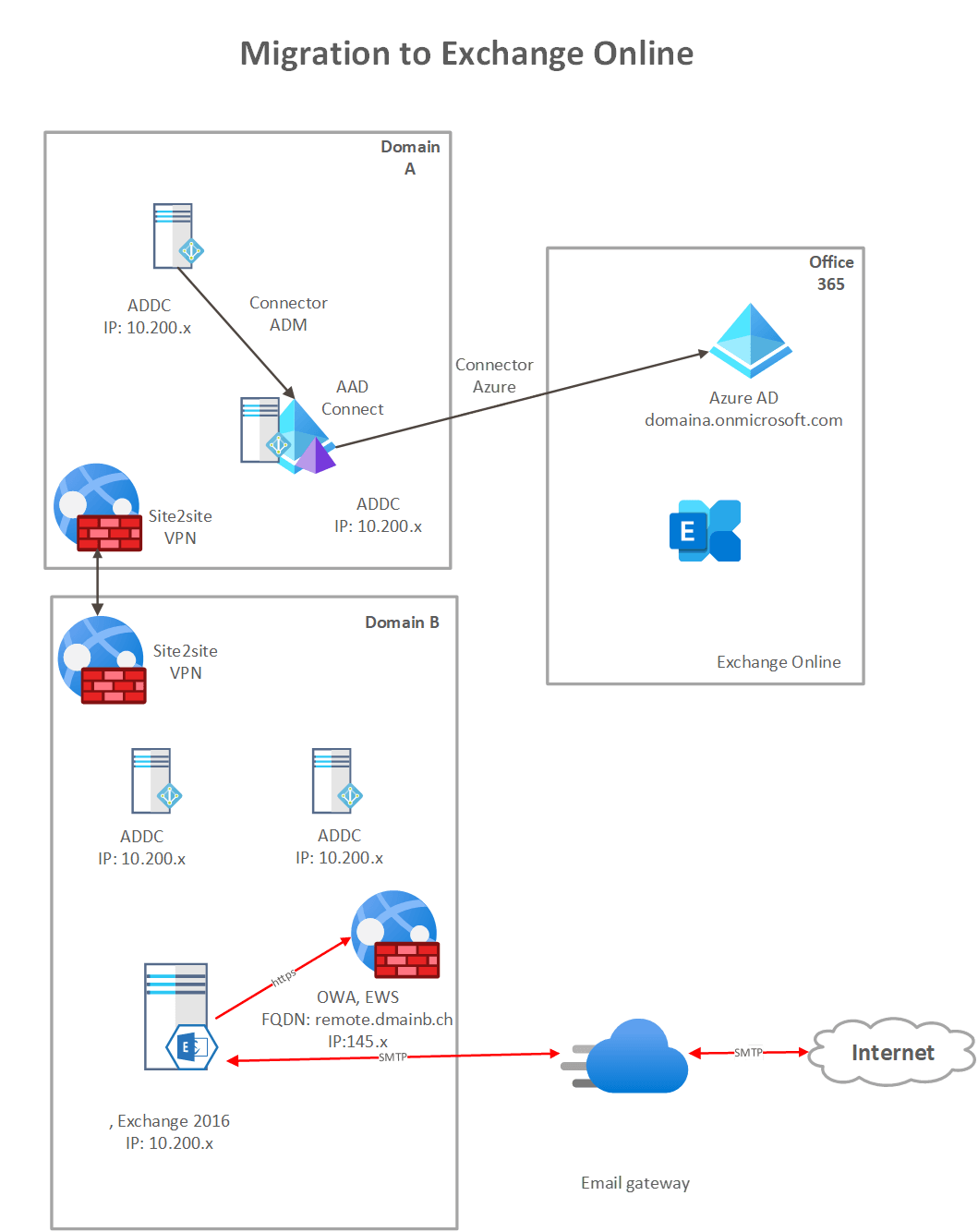
The situation before the migration was such that the domain AD for “Municipality A” was already set up with AAD Connect on an O365 tenant, with email hosted on EXO.
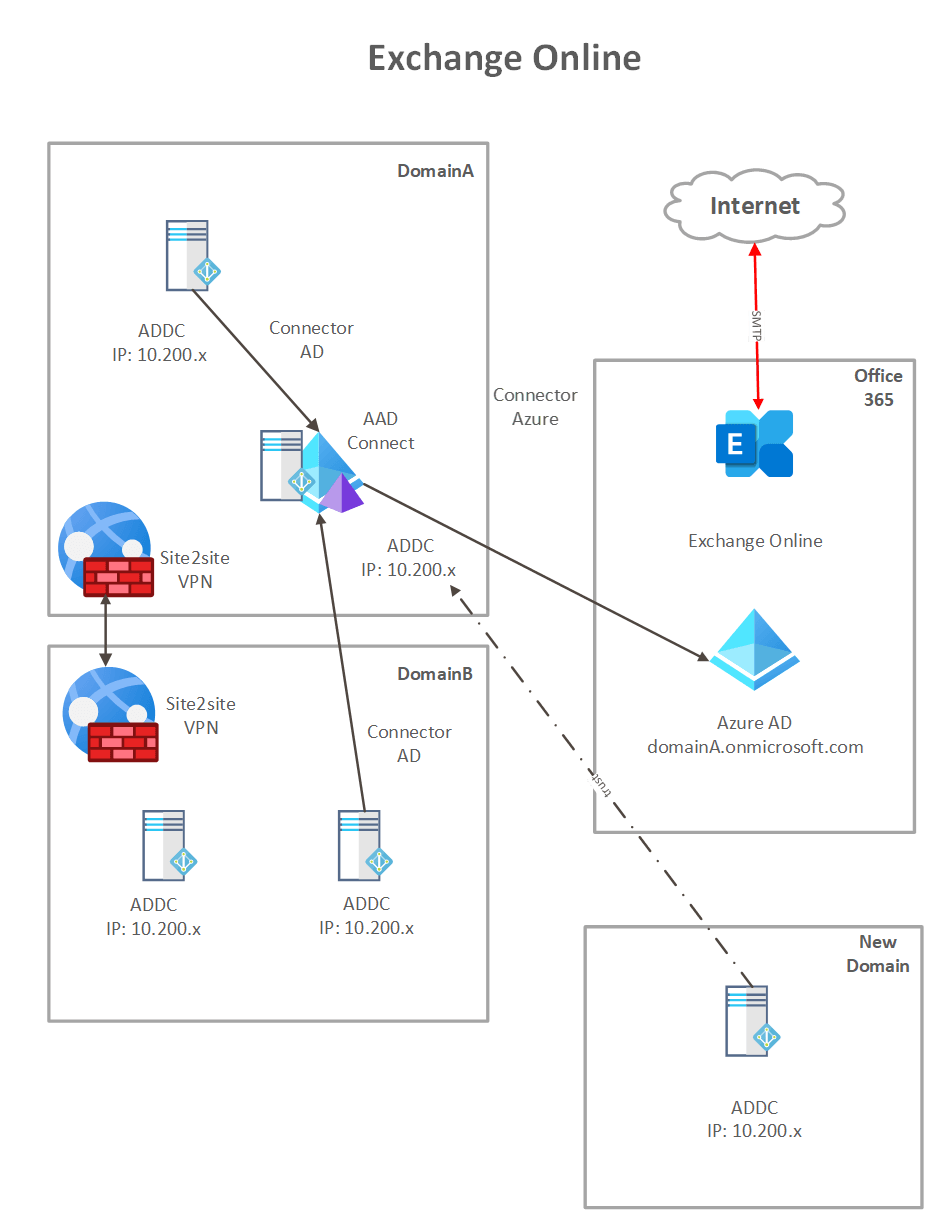
"Town B" had its own Active Directory with an Exchange OnPrem 2016. As part of the reorganization of the two municipalities, plans were made to create another AD with trusts between this new AD and those of Municipalities A and B; user accounts were to remain in their AD respective systems.
The aim, in terms of email, was to migrate the mailboxes of "commune B" into the "commune A" holding while keeping their existing email addresses.
In a second step, a new e-mail address was defined for all mailboxes.
Architecture Before the migration
Architecture After the migration
Finally, we provided post-installation supportmigration as well as the necessary training to the client so that they could be as self-sufficient as possible. At the end of the migration, we decommissioned their Exchange OnPrem server.
04
Result
The new municipality, even with limited IT support, can now safely use the email system protected by Microsoft.
Based on the same technologies
Our offers on this topic