


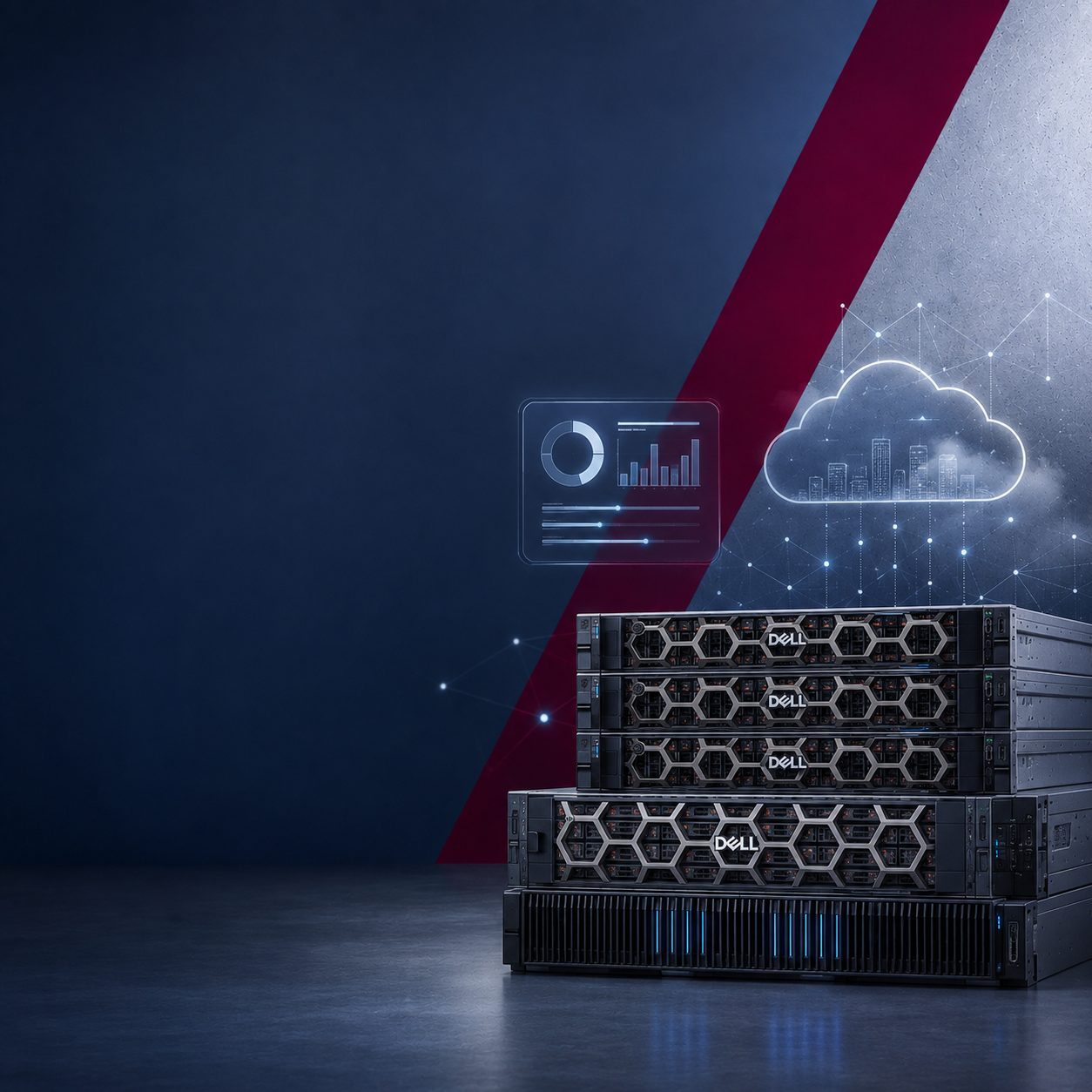
Equipment / Dell Technologies / Dell APEX
On-premises infrastructure, paid for on a pay-as-you-go basis.
And the honest question: Is it really cheaper than buying it?Purchasing infrastructure requires planning for the necessary capacity and incurring expenses before you can use it. Dell APEX offers subscription and pay-as-you-go models for deploying Dell hardware in your datacenter or on-premises. We work with you to assess whether this model is right for your organization—even when the answer is no.
This is not a staggered payment plan
Spreading the cost of equipment over several monthly payments is already a thing—it’s just called something else. APEX combines four elements: infrastructure, contractually committed capacity, measurement of your actual usage, and deployment and support services.
The equipment is installed on your premises
Applications retain the performance, location, and control of an on-premises infrastructure. What changes is how you access them—not where your data runs.
It's a payment method, not a hosting service.
Backup capacity can be installed in advance
Depending on the solution, additional capacity is installed at the same time as the committed capacity. It remains on standby—turned off or inactive—and becomes available without having to wait for an order, delivery, or installation.
That's what saves weeks, not francs.
Usage is measured and therefore billed
The monthly bill is based on the capacity committed under the contract, plus any resources actually consumed beyond that amount. The mechanism is simple; it’s determining the level of commitment that requires some effort.
The number you sign is the number of the commitment.
How the model is being implemented
Five steps, in this order. The first is the only one that requires a difficult decision; the others follow from it.
Selecting Technologies and Committed Capacity
You choose the technologies, the initial capacity, and the services you need. This is where you determine your level of commitment, and it’s the only decision on the list that you pay for throughout the entire term of the contract.
Dell installs the committed capacity and the reserve
The infrastructure is set up with a capacity that meets your typical needs and, depending on the solution, additional capacity that is already available to accommodate growth or spikes in demand.
Consumption is measured continuously
Monthly billing is based on the contractual commitment and the additional resources actually used. You gain access to new capabilities without having to go through another cycle of purchasing, delivery, and installation.
The services are covered by the contract
Deployment and support are included in the agreement. Infrastructure monitoring, administration, and management services can be added, depending on what you wish to handle yourself or delegate.
Preparations for the end of the contract begin at the start
Terms for returning, renewing, or exchanging materials: these provisions are only truly useful when you sign the agreement. We'll review them with you at that time, not in the last quarter.
Three offerings, from individual components to entire fleets
APEX can cover a specific technology, an entire infrastructure, or the lifecycle of workstations. The scope affects the calculation just as much as the model itself.
Just one component of the infrastructure, paid for on a pay-as-you-go basis
Dell servers, storage, data protection, private platforms, and hyperconverged infrastructure. Additional capacity can be pre-installed to support growth without having to wait for a new deployment.
The right scope whena single component of the infrastructure has needs that are difficult to predict.
An entire infrastructure under a single contract
A customized offering that applies pay-as-you-go billing to a significant portion—or even the entire— datacenter. It can combine multiple technologies, multiple sites, and related services under a single contract and billing arrangement.
The appropriate scope when multipledata centers need to be monitored and billed together.
Workstations and Their Lifecycle
A subscription that covers computers, monitors, peripherals, software, and lifecycle-related services: configuration, deployment, support, administration, and equipment return at the end of the contract.
The right scope whenupgrading the IT infrastructure takes more time than it's worth.
When Buying Is Still the Best Choice
This is the section you won't find at most retailers, and it's the one we find most useful. Comparing a purchase price to a monthly payment isn't enough —you have to put both models on an equal footing over the entire term.
APEX offers flexibility and predictability. It isn't always cheaper.
The pay-as-you-go model is truly beneficial when needs vary, when growth is difficult to predict, or when the organization prefers to spread out its expenses rather than commit to them all at once. It is not automatically beneficial in other cases.
In addition to the two amounts, the assessment must take the following into account:
- the term of the contract, and what happens if your needs decrease before it ends;
- the minimum consumption charge, which must be paid even if the minimum is not reached;
- which services are included, and which are billed separately;
- opportunities for career advancement during the term of the contract;
- the terms for terminating the contract, including the return of equipment.
We compare the two models in terms of their total cost, flexibility, and impact on your operations. If the traditional purchase option comes out on top, we’ll say so—and that has happened. A recommendation that can lead to only one conclusion is not a recommendation.
Pay-as-you-go does not eliminate the need for capacity planning
He's changing it. The contract is based on a minimum committed capacity, supplemented—depending on the solution—by installed reserve capacity. This is the only figure you sign off on, and it can be off in either direction.
If the committed capacity is too high, it negates the benefit of the model
You’re constantly paying for capacity you don’t use, and you end up with the drawbacks of purchasing without actually owning it. This is the most common scenario, because it provides peace of mind when signing the contract.
If the committed capacity is set too low, the reserve is constantly being used up
The additional capacity ceases to be a reserve and becomes part of normal consumption, and the monthly cost consistently exceeds what had been anticipated.
What the analysis should focus on
Current consumption—both measured and unreported. How it has changed over the past few years. Its seasonality, if your business experiences any. And the projects already planned for the duration of the contract.
We base our level of commitment on these four elements to ensure that we maintain both flexibility and cost control.
What is your situation?
Eight starting points. Some refer to APEX, others do not —and that’s the first useful way to sort them.
A large initial investment is holding you back
You're looking to spread out the cost of the infrastructure over the term of the contract rather than paying it all at once.
Your needs are changing faster than your purchasing cycles
Do you want to have additional capacity without having to wait for an order, delivery, and installation?
It's hard to predict your usage
Your projects, data volumes, or workloads fluctuate significantly from quarter to quarter.
Several technologies are reaching the end of their lifecycle at the same time
Servers, storage, data protection, and hyperconvergence must be upgraded as part of a consistent financial and contractual approach.
Your data must remain on your premises
Your requirements for performance, security, or control mean you cannot entrust all your applications to a large hosting provider.
Monitoring multiple data centers separately takes up your time
Are you looking for a single contract, usage tracking, and billing for multiple infrastructures?
Day-to-day operations are placing too much of a burden on your teams
Your teams want to outsource deployment, monitoring, maintenance, or certain routine operations.
Upgrading your computer equipment takes too much of your time
You would like to bundle equipment, services, and their replacement into a single subscription.
What the Contract May Cover
APEX carries equipment, and that equipment has its own pages. Here's where to find them.
Servers, whether purchased or used on a pay-as-you-go basis
The four product lines— PowerEdge —and the chain that connects what you measure to what you buy.
View servers StorageData storage and its usable capacity
Block, file, and object; six platforms; and what those reduction rates actually mean.
View Storage International ShippingEquipment shipped to your overseas locations
Six Incoterms Explained, Customs, and When Buying Locally Is Cheaper.
See International ShippingPay for an artificial intelligence platform on a pay-as-you-go basis, on-premises. When multiple departments want their own assistant without each having to purchase a server, the enterprise platform compares to cloud over three years—the architecture comparison tool sets the criteria.
Let's talk about your infrastructure model
Tell us about your usage, and we'll compare the two plans
What you’re actually using today, how that has changed over time, and the plans that have already been decided. With these three factors, comparing buying versus renting becomes a calculation rather than a matter of opinion.
What we offer is a meeting with the engineers who will do the work. The energy consumption assessment and the comparison of the two models are part of the scope of work. The discussion that precedes them, however, costs nothing and is often enough to determine which option is best for your situation.
Renens, Sion, Châtel-Saint-Denis
Microsoft Gold Partner and a Gold Partner Dell Technologies. We sell the hardware and install APEX—that’s what makes the comparison verifiable.
Renens VD +41 21 806 37 15
Sion VS +41 27 552 00 22
Châtel-Saint-Denis FR +41 26 322 59 05