


GPT-6 Astra in Microsoft Foundry: What's Available and Where the Data Is Processed
Microsoft announced GPT-6 Astra on Microsoft Foundry on September 3, 2026. Access is available through the Limited Access Program; neither of the two paid deployment options guarantees processing within the EU Data Boundary; and pricing is not yet listed on the pricing page Azure OpenAI.
GPT-6 Astra, OpenAI’s latest state-of-the-art model, is beginning its rollout in Microsoft Foundry through the Microsoft Foundry Limited Access Program. Microsoft announced this on September 3, 2026, and stated that access will be extended to participating customers. Access remains subject to eligibility criteria determined by Microsoft.
The Learn page titled “Foundry Models sold by Azure ” was updated on September 4, 2026, the day after the announcement, and it mentions neither GPT-6 nor Astra: the most recent GPT model listed is GPT-5.6. Four pricing tiers accompany the announcement.
| Deployment | Home | Cache entry | Cache Writing | Exit |
|---|---|---|---|---|
| Standard Global (brief overview) | 10.00 USD | 1.00 USD | 12.50 USD | 50.00 USD |
| Standard Global (long context) | 20.00 USD | 2.00 USD | 25.00 USD | 75.00 USD |
| Standard Data Zone (US) (short context) | 11.00 USD | 1.10 USD | 13.75 USD | 55.00 USD |
| Standard Data Zone (US) (long context) | 22.00 USD | 2.20 USD | 27.50 USD | 82.50 USD |
Prices as of September 4, 2026, from the blog post Azure, in dollars per million tokens. Billing is based on actual usage, with no reserved capacity commitment, and Microsoft notes that actual usage and costs vary depending on workload and configuration. Microsoft does not publish Swiss pricing for this model—see below.
Access depends on eligibility criteria that Microsoft does not document on its Limited Access page
Microsoft designates certain models sold by Azure as Limited Access Services, and access to these models is subject to eligibility criteria determined by Microsoft. The general rule is that a customer Azure does not need to submit any form to use a template; the two exceptions are accessing a template designated as a Limited Access Service, and requesting changes to the Guardrails or abuse monitoring.
The page containing this policy does not mention either GPT-6 or Astra, and the two forms it publishes pertain to guardrails and abuse monitoring, not access to a model. Microsoft does not document any steps that an administrator can take on their own to request Astra; the post merely states that access will be extended to participating customers.
Additional eligibility criteria apply to a related requirement that arises when designing an agent: while any customer can adjust the severity thresholds for Guardrails, disabling them in whole or in part requires approval, which is reserved for customers and partners supported by a Microsoft account team or participating in an eligible program.
Global can handle inference in any region Azure; the US Data Zone keeps it in the United States
The deployment type determines where the service processes prompts and responses. The rule for data at rest is different, and it is explained in the following paragraph.
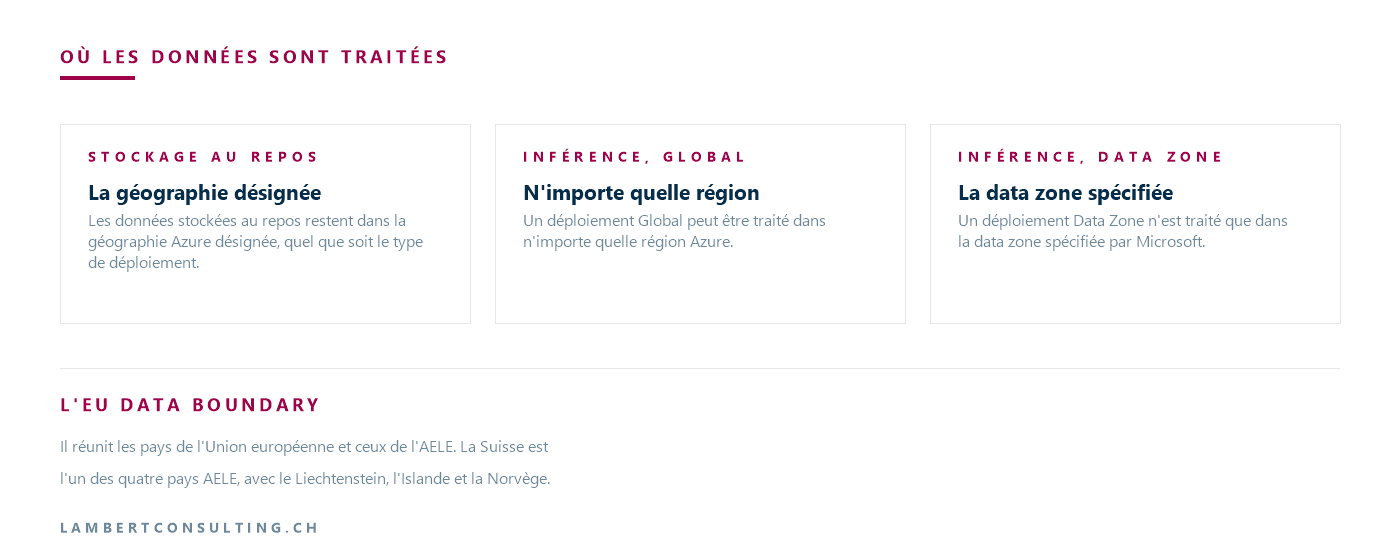
Data stored at rest remains in the designated geographic region Azure designated region, and this applies to all types of deployments. It is inference that follows different rules:
- A global deployment can be processed in any region Azure ;
- A Data Zone deployment is processed only in the data zone specified by Microsoft, which can be the United States, the European Union, or the Asia-Pacific region. In the U.S. data zone, the service processes data anywhere in the United States.
The four pricing tiers published for Astra cover two deployment types: Standard Global and Standard Data Zone (US), each available in both short-context and long-context versions. No European data zones are included. These are the two deployment types that Microsoft mentions in its announcement, leaving it up to the customer to choose based on their workload’s needs.
Note: Whether you are using a Global Standard deployment or a Data Zone Standard deployment, a service outage in the primary region affects all traffic that was originally routed to it. Microsoft refers readers to its High Availability and Recovery Guide for more information on this topic.
No paid Astra deployment guarantees processing within the EU Data Boundary, of which Switzerland is a part
The EU Data Boundary encompasses the countries of the European Union and those of the EFTA, and Switzerland is one of the four EFTA countries, along with Liechtenstein, Iceland, and Norway. This is the point that the division of responsibilities between the provider and the business user brings to life in an AI project. Microsoft is committed to storing and processing customer data for its online business services within this boundary, Azure including; transfers outside this scope may still occur under limited circumstances. This scope uses or may use data centers located in Switzerland.
An EU data zone, therefore, processes data within that boundary. It does not exist in the Astra pricing plan. A Global deployment, on the other hand, can perform inference in any region Azure, and the U.S. data zone keeps it in the United States: neither option keeps the processing within the EU Data Boundary.
A company that has chosen Azure its Swiss regions does not find this level of proximity in this model. The pricing scope as of September 4, 2026, does not meet a processing requirement within the EU Data Boundary that is already recorded in a risk register or a client commitment, and the issue will be reopened if a European data zone is introduced for this model.
The order in which the deployments took place is documented, but the date is not
Microsoft describes a fixed sequence: new deployment types are first released in Global, then in Data Zone, and finally in deployment types associated with a specific geographic region. Microsoft also states that Global deployments receive the new models first. Astra is billed only for the first two stages of this sequence.
Geographically-specific types are released last, have no guaranteed availability date, and depend on the capacity freed up by the retirement of older models. Microsoft notes that it may add regions to a data zone without prior notice: coverage may therefore expand without announcement, and a list of regions compiled on a given date may subsequently be incomplete.
Azure Policy targets a deployment type based on its SKU name
A policy can be set Azure before gaining access to the model. A deployment type has an SKU name: GlobalStandard for Global Standard, DataZoneStandard for Data Zone Standard. Microsoft documents the use ofAzure Policy to disable access to a specific deployment type, using that name.
A rule Azure A Policy rule consists of a block if and a block then, and it is in the then that defines the effect applied when the conditions of the if are met. The excerpt published on the Foundry page ends at the if : You need to add the block then and its effect, deny to deny the request or audit to let it pass while pointing it out. By replacing GlobalStandard by the SKU to be restricted:
{ "mode": "All", "policyRule": { "if": { "allOf": [ { "field": "type", "equals": "Microsoft.CognitiveServices/accounts/deployments" }, { "field": "Microsoft.CognitiveServices/accounts/deployments/sku.name", "equals": "GlobalStandard" } ] }, "then": { "effect": "deny" } } }Establishing this rule before the model is released prevents a situation where a global deployment is created as a test and then forgotten in production. The constraint then applies to all deployments within the targeted scope, including those that no team noticed.
Microsoft has not yet posted these prices on its pricing page
The Pricing Page Azure OpenAI includes the following note: GPT-6 pricing is currently being published, and Microsoft directs users to the blog post to find it. The amounts in the table above are therefore taken from that post, which was the only Microsoft source listing them as of September 4, 2026.
The pricing page does list the Swiss franc among its currencies, but any amount displayed in a currency other than the dollar is a conversion of the price into dollars: Microsoft recalculates it each month based on the London closing rates recorded two business days before the last business day of the previous month, and the rate thus determined applies to all transactions in the following month. Microsoft also presents these amounts as estimates rather than offers. As long as the pricing page does not list the Astra, there is no franc amount available for this model, and calculating it yourself from the dollar amount would yield a figure that no Microsoft page confirms.
One final follow-up point: as of September 4, 2026, no Azure Updates mentioned GPT-6 Astra as of September 4, 2026. The blog post is currently the only Microsoft publication that mentions Astra; the pricing page will indicate the transition to a standard pricing plan.
What Microsoft Documents Regarding Data Protection, and What Is Left to the Customer
Microsoft states that prompts and outputs are not used to train the models. The post specifically lists, among its security and compliance capabilities, Microsoft Entra for identity and access, encryption in transit and at rest, private network options, role-based access controls, content filtering, and security assessments.
Microsoft then clarifies the scope of these capabilities: they help implement protections and maintain control, but they do not eliminate risk or replace each organization’s responsibility to select and configure controls appropriate for its specific scenarios and regulatory requirements.
Microsoft warns that, with regard to computer-based capabilities that also target workflows without a dedicated web API : the content displayed in an application may be incomplete, misleading, or designed to influence an agent’s behavior. In response, Microsoft specifically mentions scoped credentials, approved resources, human checks on high-stakes actions, and activity logs.
In terms of performance, OpenAI reports state-of-the-art results on a selection of computer use evaluations, and Microsoft notes that performance varies depending on the task, tools, configuration, and safeguards in place. OpenAI presents Astra as its best-aligned model to date and plans to publish alignment, safety, and computer use evaluations in its launch documentation. Microsoft cites “ Power BI ” among the use cases: Astra can build and refine dashboards.
Sources
- GPT-6 Astra: Frontier Intelligence for Work, Now Available in Microsoft Foundry — blog Azure, September 3, 2026
- Understanding Deployment Types in Microsoft Foundry Models — Microsoft Learn
- Details of the Policy Definition Structure and Policy Rules — Microsoft Learn
- Azure Policy Definitions Have No Effect — Microsoft Learn
- Azure Impact of Policy Definitions Audit — Microsoft Learn
- What Is the EU Data Boundary? — Microsoft Privacy
- Limited Access to OpenAI' Azure s in Microsoft Foundry Models — Microsoft Learn
- Azure OpenAI Service Pricing
- Foundry Models sold by Azure — Microsoft Learn
What an article Can't Know
An article describes what applies to everyone. What varies from one organization to another is the inventory: which applications, which accounts, and which pieces of equipment are actually involved in your organization. The inventory determines the scope of the effort, and it cannot be summarized on a single page.
You'll be speaking directly with the engineers who will be doing the work, not with a middleman. We'll respond within 24 business hours.
Check what is still true
Announced dates are sometimes postponed, products are renamed, and conditions change. The blog tracks these topics over time: when a rule changes, a new post announces it.
Search for a topic in the blogIn the same issue
Three articles on the same topic. The blog has 155 articles, all of which are freely available.