


Choosing a Microsoft Partner: What the Designations Indicate
You’re comparing several service providers for a project Microsoft 365. All of them display a Microsoft badge on their homepage, and none of these badges indicate which one has already completed a project similar to yours. The partner program changed in 2022: the Gold and Silver statuses were removed and replaced with designations based on a score. Understanding what this score measures—and, more importantly, what it doesn’t measure—allows you to ask the few questions that will help you distinguish between candidates who seem similar.
What Microsoft has been stating since 2022
A Microsoft partner, as defined by the program, is a company that has joined the Microsoft AI Cloud Partner Program. Microsoft refers to a company that is a member of the program and offers software, services, or solutions to its customers as a Solutions Partner. The Gold and Silver competencies from the previous program were discontinued on September 30, 2022, and replaced with these Solutions Partner designations. Partners who still held these designations were able to renew their benefits for a limited time, with the final date for purchase or renewal being January 21, 2025. Microsoft now asks partners to no longer refer to Gold and Silver.
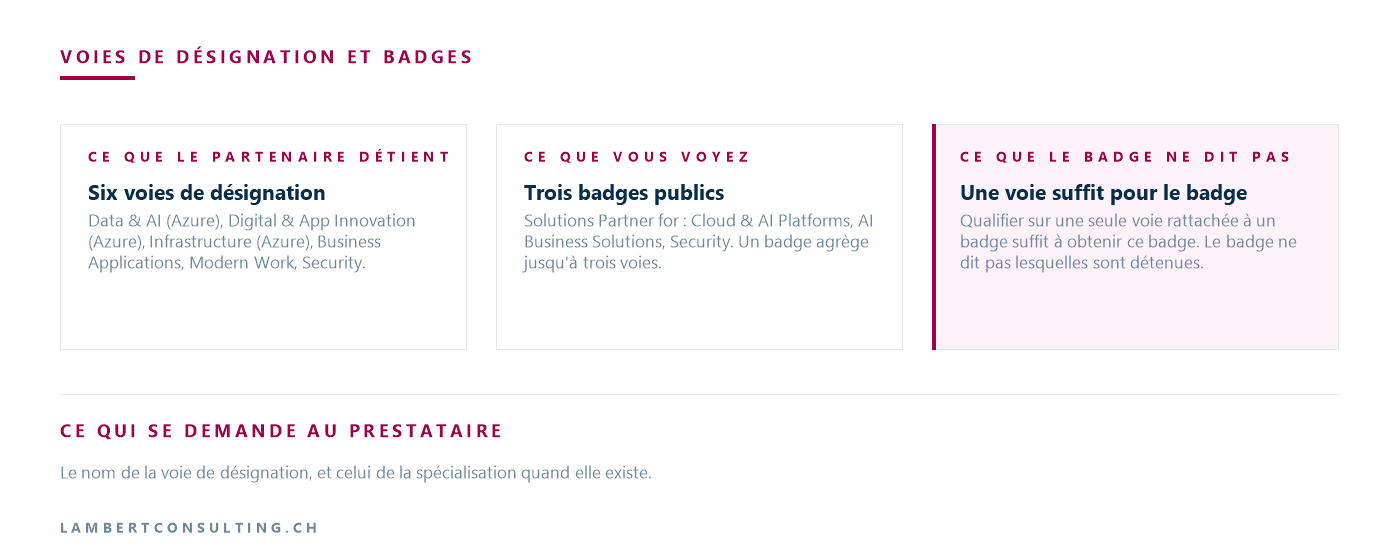
There are six career tracks: Data & AI (Azure), Digital & App Innovation (Azure), Infrastructure (Azure), Business Applications, Modern Work, and Security. Each is earned based on a capability score that measures three factors: performance, team training, and customer success. A minimum score of 70 out of 100 is required, with points in every category and subcategory. Therefore, none of the three categories can score zero. The threshold ensures a presence in all three; it does not guarantee a high level in each one.
Scores change throughout the year. Microsoft generally updates the performance and customer success subcategories on the 20th of each month, and the training subcategories within ten days of certification.
The badge displayed does not indicate which of the six lanes is occupied
The six routes are listed in three publicly visible badges.
| Designation Path | Badge displayed |
|---|---|
| Data & AI (Azure) | Solutions Partner for Cloud & AI Platforms |
| Infrastructure (Azure) | Solutions Partner for Cloud & AI Platforms |
| Digital & App Innovation (Azure) | Solutions Partner for Cloud & AI Platforms |
| Modern Work | Solutions Partner for AI Business Solutions |
| Business Applications | Solutions Partner for AI Business Solutions |
| Security | Solutions Partner for Security |
Qualifying in a single track associated with a badge is sufficient to earn that badge. A provider listed as a Solutions Partner for Cloud & AI Platforms can therefore hold all three tracks Azureor just one: the badge is identical in both cases. The same applies to AI Business Solutions, which covers both Modern Work and Business Applications. The partner, for its part, continues to work with the six designations individually; the public badge aggregates the ones the partner has earned.
An additional badge, "Solutions Partner for Microsoft," Cloud, recognizes partners who have earned all six designations.
The relevant question, therefore, concerns the name of the street, not the name on the badge.
The score reflects the entire company, not your project team
A partner receives its badges and benefits at the global account level and can then distribute them among the accounts for its various sites. Microsoft leaves this distribution up to the group’s discretion. The site that is assigned your application may therefore bear a designation earned by the entire organization, even if none of its employees contributed to the score—or it may not bear it at all, since the group is under no obligation to assign it to that site.
The second limitation relates to the timeline. Microsoft verifies whether an organization has maintained the 70-point threshold only on the anniversary date—and not before. An organization that falls below the threshold between two anniversary dates retains its designation and badge until that date. The badge you are looking at therefore certifies a score recorded no later than one year prior.
The job title indicates what the company as a whole does. It does not indicate who will handle your case.
The specialization that fits your project
In addition to the certification track, specializations validate expertise in a specific technical scenario. Microsoft mandates a specific order: you must first be enrolled in the corresponding certification track to enroll in a specialization. These specializations demonstrate the ability to deliver project-based services in the relevant scenario.
The one that matters to you is the one that covers your project. As of August 28, 2026, Microsoft’s list of specializations included twenty-seven, spread across four areas, one of which was marked as retired.
| Field | Published Specializations | Prerequisite Course |
|---|---|---|
| Azure | AI and Machine Learning on Microsoft Azure ; Analytics on Microsoft Azure ; App Modernization on Microsoft Azure ; Build and Modernize AI Apps with Microsoft Azure ; DevOps with GitHub on Microsoft Azure ; Hybrid Cloud Infrastructure with Microsoft Azure Stack HCI; Infrastructure and Database Migration to Microsoft Azure ; Microsoft Azure VMware Solution; Microsoft Azure Virtual Desktop; Networking Services in Microsoft Azure ; SAP on Microsoft Azure | Infrastructure, Data & AI, Digital & App Innovation, or Business Applications, depending on the specialization |
| Modern Work | Calling for Microsoft Teams ; Customer Solutions for Microsoft Teams ; Meetings and Meeting Rooms for Microsoft Teams ; Secure AI Productivity; Modernize Endpoints; Adoption and Change Management, removed | Modern Work, and Security, Too, for Secure AI Productivity |
| Security | Cloud Security; Identity and Access Management; Data Security; Threat Protection | Security |
| Business Applications | Agentic Business Solutions; Finance; Sales; Service; Small and Midsize Business Management; Supply Chain | Business Applications, Digital & App Innovation, or Modern Work for Agentic Business Solutions |
None of these twenty-seven specializations includes a “ migration ” to Microsoft 365, and none includes Power Platform. These two projects therefore do not have a specialization named after them, which changes the way a Microsoft partner is selected to carry them out.
Migration toward Microsoft 365
No specialization specifies a migration "vers" Microsoft 365. The Modern Work field lists six, including one that has been removed, and none of them bears that name. Neither the badge nor the name of a specialization will therefore set your candidates apart here. What sets them apart is the nature of the existing infrastructure they’ve already migrated—mailboxes hosted on your servers, a second tenant following an acquisition, legacy file sharing—and what they plan for the weeks following the switchover, when users discover what has changed. When an end-of-support date triggers the project, Microsoft’s end-of-support dates as of October 13, 2026, provide the timeline for upcoming end-of-support events.
Telephony, meetings, and customer service in Teams
There are three specializations Teams, and their titles do not refer to the same work: Calling for Microsoft Teams, Meetings and Meeting Rooms for Microsoft Teams, and Customer Solutions for Microsoft Teams. All three fall under the Modern Work track. “ Teams Partner” therefore provides no useful information until you specify which one corresponds to your project. When replacing a phone system, the first track is the one that matters; the “ migration ” to “ Teams Phone” provides the framework.
Identity and Access Security
Security has its own track, "Security," under which Microsoft lists four specializations: Identity and Access Management, Cloud Security, Data Security, and Threat Protection. A fifth specialization, Secure AI Productivity, also lists Security among its prerequisites. A provider listed as a Solutions Partner for Security holds that track; it does not necessarily hold the specialization that corresponds to your specific area. If your project focuses on accounts, groups, and access rules rather than attack detection, you should specify Identity and Access Management. The “ Microsoft 365 ” and “ Entra ID ” resources list the latest developments in this field.
Infrastructure modernization with Azure
Three of the six tracks focus on Azure and are grouped under the same badge. Ask which one you hold, by naming it: Infrastructure, Data & AI, or Digital & App Innovation. This is the area where Microsoft offers the most specializations—eleven—and where their names provide the clearest guidance: Microsoft Azure VMware Solution doesn’t mean the same thing as SAP on Microsoft Azure, nor does “Infra and Database” Migration to Microsoft Azure. Ask for the exact name. The decision between keeping your servers and moving them must be made before choosing a provider: “Azure ” or an on-premises infrastructure sets the terms for this comparison.
Automation with Power Platform
No specialization is named “ Power Platform.” Those related to “Business Applications” refer to business domains—Finance, Sales, Service, Supply Chain, and Small and Midsize Business Management—to which “Agentic Business Solutions” is added; this can be obtained through “Business Applications,” “Digital & App Innovation,” or “Modern Work.” In this area, the selection process is therefore based on comparable projects and on how the service provider quantifies long-term operational costs—not just development costs: the actual cost of an application Power Apps shows where the money goes.
What to Check Before Signing
- The exact name of the designation track, not the name of the badge. A badge can cover up to three tracks; the track designates a domain. A response given verbally during a meeting leaves no record once the project is underway.
- The people who will be working on your project. Their qualifications, what similar work they have previously completed, and whether they will remain the same from the scoping phase through to commissioning. The appointment does not address any of these three questions.
- What happens after the system goes live. Who is responsible, within what timeframe, and whether the team that operates the system is the same one that deployed it.
- A project comparable to yours in terms of size and complexity. Confidentiality often prevents us from naming the client; however, it does not prevent us from describing the context, the scope, and what went wrong along the way.
- Start with a limited scope. Conducting an assessment or a pilot project in a single department allows you to evaluate the method before committing the full budget.
What Skews a Comparison of Offers
Compare the total costs before looking at the services. A partner’s price isn’t just for licenses—it also covers scoping, architecture, migration, security, and support. Two similar price quotes may cover two entirely different scopes of work. Compare the services side by side before comparing the numbers.
Confusing a reseller with an integrator. A reseller transfers licenses to you. An integrator configures, migrates, secures, and provides training. Many companies do both, but it’s never automatic, and a quote that lists only licenses does not cover the second service.
Retain a title that is being phased out. Microsoft is phasing out the Azure Managed Services Provider: no new registrations will be accepted starting September 15, 2026, and renewals will close in January 2027. Partners who are already registered will retain their benefits until their anniversary date. Microsoft positions this program, along with the specializations, as going beyond mere designation, and renewal requires an audit. A provider that still offers this program must therefore be able to specify what will replace it. For its part, Microsoft recommends the Frontier Partner specialization to eligible partners.
Treat user training as an option. The only specialization whose title referred to adoption and change management—“Adoption and Change Management ”—is marked as discontinued. The need, however, remains: it is simply no longer certified by a badge, and is therefore reflected in the proposal—which specifies who is being trained, for how long, and what resources will be provided once the training is complete.
Our Reading
The most useful identifier isn't the largest badge displayed on a home page; it's the name of the track, followed by the name of the specialization, if applicable. A badge can represent up to three tracks; a track refers to a field of study.
This advice has its limits. In two of the five projects—one migration to Microsoft 365 and one involving automation Power Platform — no specialization specifically refers to your project. Asking “which specialization?” will yield no useful information in these cases, and the selection process relies entirely on comparable projects and the people assigned to them.
When both are possible, we prefer specialization over the broadest designation. A designation applies to the entire organization, including employees who will never work for you; a specialization focuses on a specific technical scenario and assumes that the designation has already been obtained. For a migration standard project with no particular identity or integration issues, the designation is sufficient to weed out unqualified candidates. As soon as the project involves identity, a line-of-business application, or a regulatory requirement, requiring the name of the specialization changes what you can include in the contract.
What You Can Check on Your Own Without a Service Provider
Microsoft publishes a partner directory in its Marketplace, featuring a search tool that uses expertise tags and takes certifications into account. Certification badges—including those for specializations and theAzure MSP Expert, appear there, with a delay of up to 72 hours, according to Microsoft. Verifying that a service provider actually holds the specializations it claims takes just a few minutes and requires no technical expertise.
The name of the certification track, however, does not appear there: the directory shows the badge, which serves as an umbrella term. This question should be directed to the service provider. A listed specialization already provides some insight, though it doesn’t always make it clear: some depend on only one track—Microsoft Azure VMware Solution implies Infrastructure, and Threat Protection implies Security—while others can be obtained through multiple tracks and therefore do not specify which one has been completed.
An important point for Swiss buyers to note: service providers in the reseller channel CSP can only publish their profiles in regions where they are authorized to operate, but other program members can publish their profiles in any country, even if they do not have an address or physical presence there. A profile listed in Switzerland does not, therefore, indicate that a team is based in Switzerland. This should be clarified and verified separately.
Lambert Consulting Here’s an example: It has continuously held a Microsoft Partner Program designation since 2010— Gold Partner until these certifications were discontinued on September 30, 2022, at which point it became a Solutions Partner—and it operates from its three offices in French-speaking Switzerland: Renens, Sion , and Châtel-Saint-Denis.
The rest of the preliminary work is entirely up to you: write down what you’re currently using, what specific problems you’re facing, who needs to be involved in the decision, and what budget has already been allocated. A service provider who receives this information can tailor their response to your situation; without it, they’ll have to guess, and their proposal will remain vague.
When It's Better to Wait Before Calling
A first meeting comes too early in three situations: you’re still framing the need in terms of a solution rather than a problem; management hasn’t finalized the budget; or the team hasn’t decided whether this issue takes priority over others. In all three cases, the proposal you receive will be more vague—not faster—and you won’t be able to compare it effectively.
This clarification requires a few meetings, and you can handle it without an outside vendor. A targeted assessment of your Microsoft environment then helps frame the discussion. Lambert Consulting can conduct this assessment if you lack the necessary in-house expertise.
Frequently Asked Questions
Does the " Microsoft Gold " status still exist?
No. The Gold and Silver tiers were discontinued on September 30, 2022, and replaced by the Solutions Partner designations. Partners who held these tiers were able to renew their benefits through January 21, 2025, the last date for purchase or renewal. Microsoft asks partners to stop referring to them.
What is the difference between a designation and a specialization?
The designation certifies a set of competencies in a specific field—there are six tracks—and is awarded to those who score at least 70 out of 100 on the competency assessment. The specialization validates expertise in a specific technical scenario, and candidates must already be enrolled in the corresponding designation track to apply for it.
Does a partner listed in Switzerland necessarily have a team in Switzerland?
Not necessarily. Outside the reseller network CSP, a program member can create and publish their profile in any country, without having an address or a physical presence there. Local presence is required, just as the working language and the ability to provide on-site support are.
How long is a designation valid?
It runs until the anniversary date, and Microsoft only verifies that the 70 points have been maintained on that date. The renewal window opens on the anniversary date; to ensure that the benefits continue uninterrupted, renewal must take place within the following 30 days.
Microsoft Sources
- Solutions Partner FAQs — Microsoft Learn
- Introduction to the Solutions Partner Program — Microsoft Learn
- Azure Managed Services s Expert Provider Program — Microsoft Learn
- Create a business profile — Microsoft Learn
What an article Can't Know
An article describes what applies to everyone. What varies from one organization to another is the inventory: which applications, which accounts, and which pieces of equipment are actually involved in your organization. The inventory determines the scope of the effort, and it cannot be summarized on a single page.
You'll be speaking directly with the engineers who will be doing the work, not with a middleman. We'll respond within 24 business hours.
Check what is still true
Announced dates are sometimes postponed, products are renamed, and conditions change. The blog tracks these topics over time: when a rule changes, a new post announces it.
Search for a topic in the blogIn the same issue
Three articles on the same topic. The blog has 153 articles, all of which are freely accessible.