


End ofAzure Communication Services as a Standalone Offering in 2028: What Needs to Be Migrated
Microsoft is discontinuing Azure Communication Services as a standalone offering on September 30, 2028. Email, SMS, WhatsApp, chat, Rooms, and ACS telephony will be discontinued; calling and Call Automation will only continue to be supported through Teams. Registration for new customers for the discontinued services will close on October 23, 2026.
Microsoft has set September 30, 2028, as the end date forAzure Communication Services (ACS) as a standalone offering. The announcement appeared in the Azure Updates on September 24, 2026, and the retirement guide published on Microsoft Learn provides service-by-service details. Microsoft cites its strategy as the reason for this decision: to prioritize communication experiences integrated into its platforms, particularly Teams, Dynamics 365 , and Azure, and to rely on partner CPaaS providers to fill in the gaps.
The removal ofAzure Communication Services does not affect all services equally. Some services are being phased out. Others remain available, but only in scenarios aligned with Microsoft' Teams s and with a new major version of the SDKs. A more immediate deadline applies to new customers: starting October 23, 2026, they will no longer be able to sign up for the services that are being phased out.
| ACS Service | Maturity Date: September 30, 2028 | Documented Microsoft alternative |
|---|---|---|
| Withdrawn | Microsoft 365 High-Volume Email (Internal), OnlineExchange | |
| SMS | Withdrawn | None in the general table; Dynamics 365 Contact Center for its customers |
| Advanced Messaging (WhatsApp) | Withdrawn | Dynamics 365 Contact Center |
| Chat, including interoperability Teams | Withdrawn | API cat Microsoft Graph |
| Rooms | Withdrawn | Meeting Interoperability Teams, API Microsoft Graph |
| Number Management (Direct Offer) | Withdrawn | Teams Phone Extensibility, Calling Plan, Direct Routing, Operator Connect |
| Direct Routing | Withdrawn | Teams Phone Extensibility, Teams Direct Routing |
| Job Router | Withdrawn | Dynamics 365 Contact Center |
| Web and Mobile UI Library | Withdrawn | None |
| Voice and Video Calling SDK | Abrupt change | Interoperability of Meetings Teams |
| Call Automation | Abrupt change | Teams Phone Extensibility, for documented scenarios |
Retrieved on September 29, 2026, from theAzure Communication Services. Call Diagnostics, Audio Streaming, Call Recording, and Closed Captions follow the same abrupt changeover schedule as Call and Call Automation.
Discontinued services or services that require application modifications: what each category means
A deprecated service is removed fromAzure and will no longer be available after September 30, 2028, even if it is used with other services that continue to be supported. After that date,API and SDK operations that depend on it may return errors indicating that the operation is not supported.
A service subject to a breaking change will continue to exist after September 30, 2028, but will only be supported if it is aligned with Teams. Standalone ACS scenarios that do not integrate with Teams —including person-to-person and application-to-person communications—are no longer supported. Microsoft lists three services aligned with Teams :
- Microsoft Teams Phone Extensibility (TPE);
- interoperability of Microsoft Teams ;
- Microsoft Teams Click-2-Call for voice applications Teams.
The affected SDKs indicate this change with a new major version number, such as 4.x.x instead of 3.x.x. Any application that wishes to use one of these services after September 30, 2028, must upgrade to this latest major version. Microsoft also notes that an eligible integration does not guarantee feature parity, either with standalone ACS or across different Teams integrations.
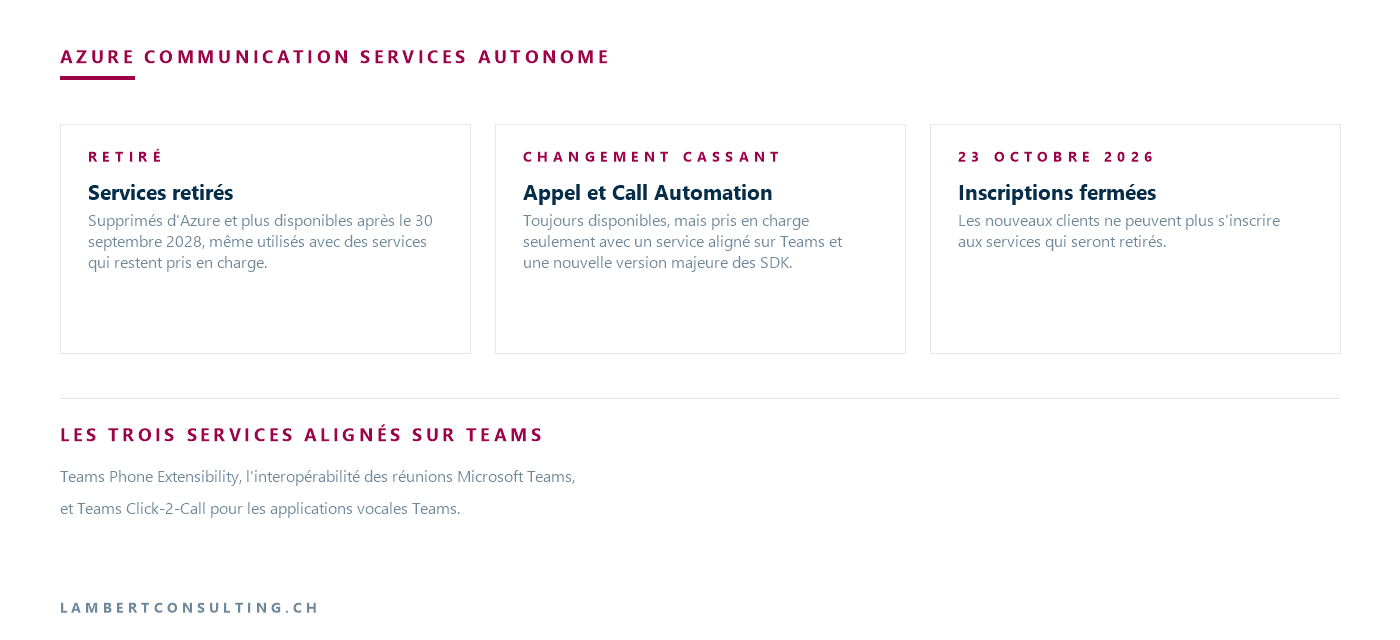
New customers: Registration for discontinued services will close on October 23, 2026; no phone numbers will be issued starting in September 2026
Effective October 23, 2026, new customers can no longer sign up for ACS services that are being phased out. Customers whose ACS resource was created before that date may continue to use it during the transition period.
Phone numbers are being restricted earlier. The withdrawal guide states that a tenant who creates their first ACS resource after the September 2026 announcement cannot request a phone number; the migration Dynamics 365 Contact Center Guide sets the effective date of this restriction as September 30, 2026. Customers who already had ACS numbers prior to the announcement may continue to acquire them during the transition period.
Support for the services will continue through September 30, 2028, including their SLA and compliance certifications. However, the ACS team is focusing on existing features and critical security and stability fixes: for services that have been retired or are undergoing a breaking change, Microsoft is not committing to new features. From September 2026 through September 30, 2028, updates required by upstream dependencies—such as Fluent, React, or .NET—or by browsers and operating systems will be handled as break-fix issues via support tickets.
Email: High Volume Email replaces only part of ACS Email
Microsoft is shifting ACS Email toward two products Microsoft 365, which do not serve the same purpose. Microsoft 365 High Volume Email (HVE) is used to send high-volume operational emails from applications and devices, but the comparison table in the guide limits it to internal sending within the tenant. Exchange Online covers both internal and external recipients, but it is designed for person-to-person messaging from licensed mailboxes, not for bulk sending, and its throughput limits apply by design.
For transactional, bulk, or marketing emails sent to external recipients, the table does not include either option, and the guide lists third-party providers from the Microsoft Marketplace: Infobip and Telesign. Verified sending domains will continue to function through September 30, 2028. Microsoft is still accepting new workloads on ACS Email—subject to change at any time—and recommends using the two-year transition period to migrate rather than to launch new solutions.
SMS and WhatsApp: Changing Providers
The guide’s table of recommendations does not list a Microsoft alternative for SMS; it mentions Infobip and Telesign. Porting an ACS number to another provider requires re-verification with an SMS aggregator, and Microsoft warns that the process may cause a service interruption. Short codes can also be ported, and the timeframes vary because their provisioning involves external providers and a regulatory review.
For WhatsApp, Microsoft cites Dynamics 365, Infobip, and Telesign, or the transfer of a WhatsApp Business Account to another Business Solution Provider via the migration WhatsApp number porting process, provided the destination provider supports it.
Telephony: The Paths Lead Through Teams Phone
ACS's two telephone services are being discontinued: Number Management, which provides direct access to phone numbers, and Direct Routing. The guide directs users to Teams Phone Extensibility and to the PSTN connections for Teams Phone:
- Since the ACS direct offering, Teams Calling Plan is the closest Microsoft-managed alternative, without SBC any carrier to integrate, provided it covers the customer’s geographic area;
- from ACS Direct Routing, Teams Direct Routing reuses the SBC and existing SIP trunks;
- Operator Connect entrusts the " PSTN " connectivity to a carrier certified under the program; the current carrier may be retained if it participates in the program.
Two practical constraints are highlighted in the guide. The same FQDN SBC cannot be used simultaneously by both ACS and Teams Direct RoutingTeams —a point to consider in the failover plan. Additionally, an ACS number must be released from ACS via a support ticket before it can be ported to Phone Extensibility.
Teams Teams is based on licenses: a Phone license for the agent, a resource account—whose license is included in Phone—and connectivity via , Teams Teams Teams PSTN Calling PlanOperator Connect or Direct Routing. For an organization already familiar with Microsoft Teams telephony, the target solution therefore leverages existing components.
Call Automation and Calls: Check Each Function in the TPE Matrix
Call Automation will continue to be supported after September 30, 2028, for the capabilities documented in eligible Teams scenarios. Teams Phone Extensibility covers incoming and outgo PSTN , supported participant and media controls, ACS recording, sending audio to a WebSocket, and real-time transcription, but not all Call Automation operations or media modes: Microsoft refers users to its TPE capabilities matrix.
Connecting Call Automation to an AI service is not sufficient to qualify as a standalone service for support after this date: eligibility depends on the relevant integration Teams or scenario Dynamics 365 . Similarly, joining a meeting Teams via interoperability does not prove support for ACS recording, server-side streaming, or Call Automation transcription. For configurations not covered in the documentation, Microsoft recommends contacting support Azure before relying on it.
ACS Chat and ACS Rooms: Graph is not an exact replacement for Chat, and Rooms does not have a path to migration
Microsoft Graph 's chat API are not a direct replacement for ACS Chat or its client SDKs. They are suitable for users Microsoft 365, guests, and supported external users whose conversations can operate under the identity, licensing, policies, and governance of Teams. An application that requires anonymous or application-defined identities, a white-label client, or consumer-facing chat outside of Teams should evaluate other providers or redesign its experience. Microsoft publishes a guide on migration migrating from ACS Chat to Microsoft Graph.
Regarding ACS Rooms, Microsoft states that Rooms and the Teams meetings created by theAPI Microsoft Graph offer similar features, but exist in two different environments and do not share a migration.
Dynamics 365 Contact Center continues, but its ACS channels do not
Dynamics 365 The Contact Center will continue to operate after September 30, 2028. However, voice, SMS, or WhatsApp configurations that still rely on the discontinued ACS capabilities will stop working. The guide from migration Dynamics 365 provides the following targets:
| Current Configuration | Documented target |
|---|---|
| Voice by ACS Direct Offer | Teams Calling Plan, by Teams Phone Extensibility |
| Voices by ACS Direct Routing | Teams Direct Routing or Operator Connect, by Teams Phone Extensibility |
| SMS via ACS | SMS via Twilio or Infobip |
| WhatsApp by ACS | Meta Direct or WhatsApp via Twilio |
| Voice Already in the Teams Phone Extensibility | No action |
No SMS or WhatsApp configurations are migrated automatically: each channel must be configured, tested, and validated in the destination service. This topic is related to the telephony topic linked to the CRM at Dynamics 365.
Data to be exported: by September 30, 2028, and within 24 hours for call recordings
Chat messages, call recordings, and operational telemetry in Azure Monitor remain exportable; however, data and telemetry from retired and standalone services are decommissioned after the retirement date. Two precautions apply immediately.
The built-in storage for ACS call recordings is temporary: a file remains available for download for 24 hours. Microsoft requires that you retrieve and archive the files and their metadata within this timeframe, or configure Bring Your Own Storage; recordings already stored in your own Azure Blob Storage are not affected by the transition.
Before deleting an ACS resource, remove its phone numbers; otherwise, the orphaned numbers will continue to be billed, and the issue can only be resolved by submitting a support ticket.
Find the relevant resources
The guide lists four tools for identifying subscriptions that use ACS:
- the recommendations fromAzure Advisor, under Advisor > Recommendations > Operational Excellence;
- The " Service Retirement " workbook fromAzure Advisor, which tracks withdrawals by resource and can be exported to CSV;
- the ACS Resource Explorer agent, which analyzes subscriptions with Copilot and suggests migration ;
- Cost Management + Billing, based on the actual usage of each resource.
Our Reading
Telephony is the clearest part of the withdrawal: each ACS telephony service has its own documented target Teams Phone, and the choices between Calling Plan, Direct Routing and Operator Connect are the same as those for any Teams Phone architecture. Outgoing email and SMS are more complex. For both of these cases, the guide does not specify any Microsoft product for sending messages from applications to external recipients: High Volume Email is limited to internal sending in its table, and outside of Dynamics 365, SMS refers to third-party providers. We would therefore treat these two communication channels as a separate provider selection process—with its own geographic coverage, verification requirements, and commercial terms—rather than as a technical update.
We would no longer launch a new project on an ACS service that is being phased out: October 23, 2026, marks the end of enrollment for new customers, and Microsoft itself recommends—for both email and Dynamics 365 messaging channels—that the transition be reserved for migration rather than new solutions. For Call Automation, we would thoroughly review each function we use against the TPE matrix before providing any cost estimates, because eligibility is determined on a function-by-function basis. And we would verify right away how call recordings are archived, since the 24-hour window is already in effect.
What to Check
- Subscriptions that include an ACS resource, via Azure Advisor and its Service Retirement workbook.
- For each resource, the services used: Email, SMS, WhatsApp, Chat, Rooms, phone numbers, Direct Routing, Job Router, UI Library, Calling SDK, Call Automation.
- Recipients of the application email: internal to the tenant or external.
- Phone numbers and short codes, their portability to the target provider, and the new verification requirement for text messages.
- The FQDN of the SBC used by ACS Direct Routing, and the addressing scheme for Teams Direct Routing.
- The Call Automation features used, compared to the Teams Phone Extensibility capabilities matrix.
- The versions of the ACS SDKs for calling and call automation, and the transition to the new major version.
- Archiving call recordings, either within the 24-hour window or using Bring Your Own Storage.
- The voice, SMS, and WhatsApp channels of the Dynamics 365 Contact Center that still go through ACS.
Microsoft Sources
What an article Can't Know
An article describes what applies to everyone. What varies from one organization to another is the inventory: which applications, which accounts, and which pieces of equipment are actually involved in your organization. The inventory determines the scope of the effort, and it cannot be summarized on a single page.
You'll be speaking directly with the engineers who will be doing the work, not with a middleman. We'll respond within 24 business hours.
Check what is still true
Announced dates are sometimes postponed, products are renamed, and conditions change. The blog tracks these topics over time: when a rule changes, a new post announces it.
Search for a topic in the blogIn the same issue
Three articles on the same topic. The blog has 142 articles, all of which are freely available.