


How does the integration of the IoT with Unified Communications (UC)?
The context
By 2020, the success of 50% of Global 2000 companies will depend on their ability to create digital experiences, services and products to dictate the future path of their business success, according to IDC. These digital experiences are aligned with the following technological innovations and are poised to become more prevalent in the manufacturing industry. IoT connectivity between manufacturing devices and equipment in industrial transformation was worth more than $178 billion in 2016 and acts as a business differentiator, giving a competitive edge. With IoT implemented in factories, it is possible to virtually monitor processes, products and assets, while ensuring transparency and business optimisation. More detailed information on manufacturing operations and equipment data allows workers and employers to automate processes and predict potential problems, prevent issues before they arise and therefore maintain operational efficiency. Similarly, IoT can provide real-time information and alert companies to faults and indicate potential problems and issues. By bringing factory machines and other equipment online, some of the responsibility for operational decision-making is transferred to the technology, freeing up employees to use their staff on more critical tasks. However, you will read in this article that the use of IoT extends far beyond the industrial sector, such as in the insurance sector, banking, government, etc.
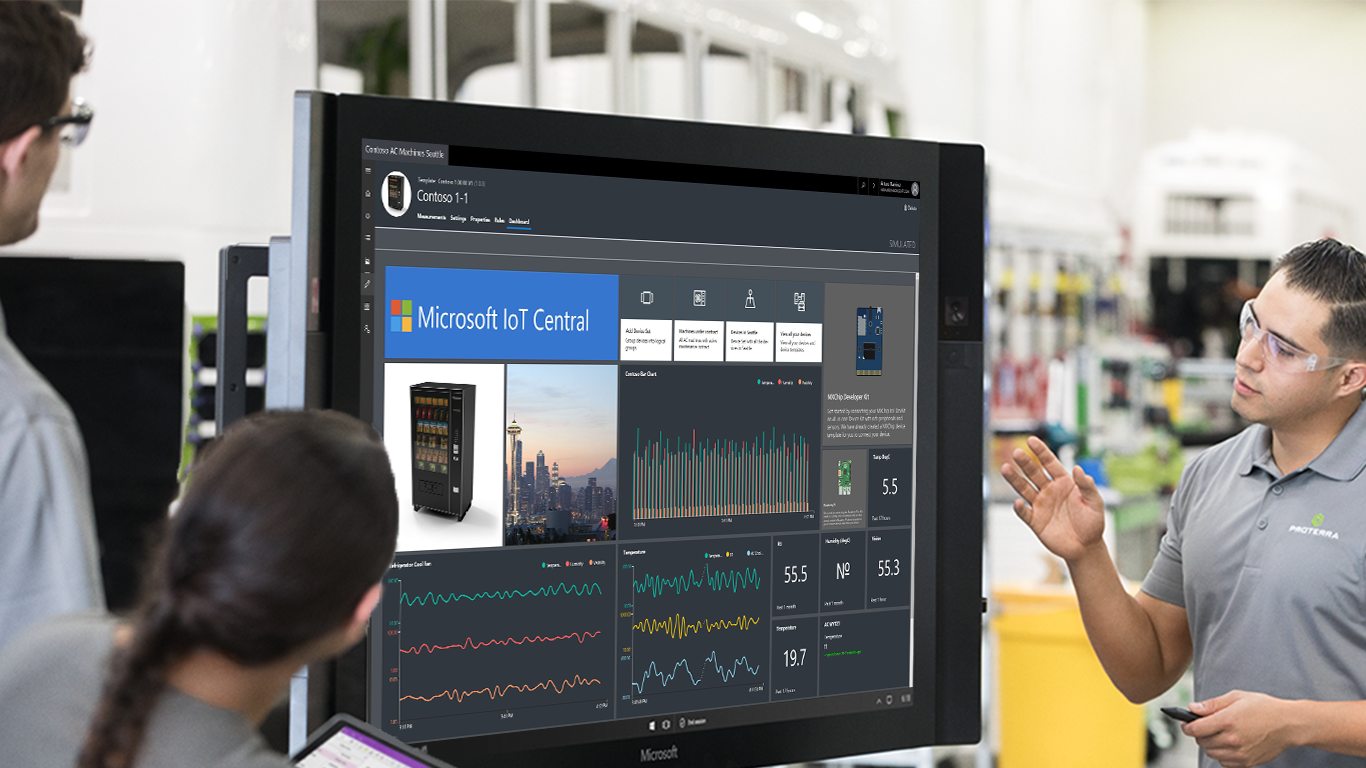
The next level of more informed decision-making is emerging through the marriage of IoT and unified communications, providing predictive and proactive actions against reactive decisions. Through predictive analytics, sensor data can help organisations better predict outcomes or problems and resolve them before they occur.
Why use theUC to connect IoT devices?
Every device connected to the IoT is assigned an IP address and can independently transmit real-time data over a network UC. IoT-connected devices use radio frequencies to collect information, which is then used to diagnose problems or to optimize and streamline certain processes.
Historically, panic buttons and other emergency systems have been composed of one-way analogue interactions, which are not useful when assessing needs. However, with IoT and connected wireless environments, universities can deploy intelligent panic buttons powered by voice, video and location services, improving the way they assess and respond to each call. The use of real-time communications not only improves security, but also services in general.
By far our favorite: in an “open office/flex office” setting, employees could interact via Skype for Business or Microsoft Teams to interact with the building while searching for available spaces. AI would suggest the most suitable location based on various parameters detected by sensors for noise, temperature, occupancy, etc. Similarly, for conference rooms, they would be able to easily find an available room or locate a room where a meeting is taking place by communicating with the connected rooms through their tools UC. The combination of connected devices and theUC would, among other things, make it possible to achieve goals such as optimizing workspaces, increasing the value of real estate assets, or simply making the premises more attractive by offering employees new services.
In the event of a fire alarm, employees would be notified directly via Skype for Business the shortest evacuation route, taking into account real-time crowding conditions. A conference call is automatically set up for all managers so they can direct their teams.
Understanding the connection between theUC and the IoT
UC is a mature technology that uses real-time communication to help people collaborate. Compared to unified communications, the IoT is new and has focused on connecting consumer devices to the Internet. One technology communicates with people, the other with devices, but it makes sense to bring these devices together. By connecting these two technologies, data can be sent without human intervention to other machines or people. As each technology evolves, more data from devices can be transmitted quickly and seamlessly. We’ve already seen this technology make its way into some vehicles through apps that provide information from the vehicle’s computer, which app users can download to their smartphones. Owners of connected vehicles can even start their vehicle, unlock it, and control the climate system from their smartphone.
The value of the IoT for businesses through theUC is enormous
"If you can measure it, you can manage it
IoT data can help businesses streamline workflows and optimise staffing levels to maximise productivity and efficiency. Data collected from IoT devices can show how problems can be proactively avoided rather than solved after they occur. At an organisational level, assets can be monitored in real time to optimise service and maintenance and delay replacement.
From a communications perspective, the IoT connects machines to employees and customers. Through unified communications, IoT data can be delivered in real time to those who can access it from any device. In the healthcare sector, data from a monitor can be sent via Unified Messaging (UM) via collaboration tools such as Skype for Business or Microsoft Teams to a doctor if an analysis detects a critical health issue. Volvo is working to integrate Skype for Business into its 90 Series vehicles, which will allow drivers and passengers to view and participate in meetings via the vehicle’s touchscreen.
And you, what do you imagine for your company?
Let's look at the added value we could bring to your project
What an article Can't Know
An article describes what applies to everyone. What varies from one organization to another is the inventory: which applications, which accounts, and which pieces of equipment are actually involved in your organization. The inventory determines the scope of the effort, and it cannot be summarized on a single page.
You'll be speaking directly with the engineers who will be doing the work, not with a middleman. We'll respond within 24 business hours.
Check what is still true
Announced dates are sometimes postponed, products are renamed, and conditions change. The blog tracks these topics over time: when a rule changes, a new post announces it.
Search for a topic in the blogIn the same issue
Three articles on the same topic. The blog has 155 articles, all of which are freely available.