


Cost Optimization: Where Generative AI Actually Reduces Expenses
Generative AI is almost always presented as a productivity gain. For a finance department, a productivity gain does not equate to a cost savings: it is time freed up for employees whose salaries remain unchanged.
The relevant question is more specific. Where does AI actually cut a line item from the budget, rather than just an hour of unspecified work? There are three situations where this is truly possible, and we must weigh them against the costs that AI itself generates—costs that do not appear on any initial estimate.
The three places where money disappears
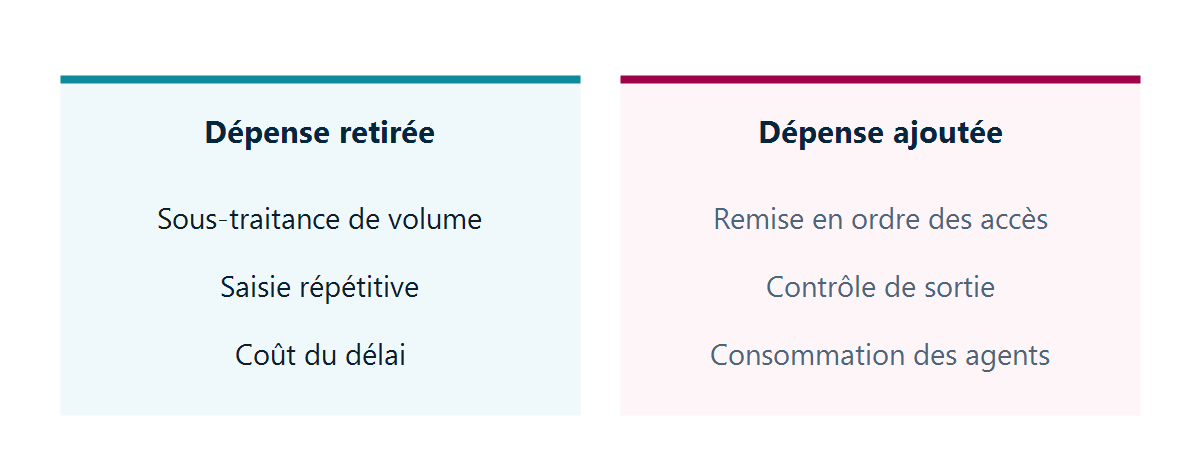
1. The volume processed externally. Everything the company outsources in terms of volume: data entry, transcription, initial screening of requests, translation of internal documents, and formatting. These are identifiable invoices, included in a budget, with a specific amount. When an agent takes on a portion of this volume, the invoice amount decreases, and that decrease is reflected in the income statement.
2. Repetitive data entry. Transferring information from a document to a system. This work is not always outsourced, but it is measurable: the number of documents multiplied by the time per document. This is the only case where one can legitimately speak of the equivalent number of full-time equivalents freed up, provided that the volume has been recorded rather than estimated.
3. The cost of delays. This is the least visible—and often the most significant—cost. A customer inquiry processed in two hours instead of two days, a quote provided the same day, a file completed on the first try: the cost saved is that of delays—with their follow-ups, lost files, and potential contractual penalties. It adds up, but only if the company was already tracking its turnaround times before getting started.
What is not on this list is just as important: assisted writing, meeting summaries, and information research. These uses are useful, widely adopted, and do not eliminate any expense line item. Presenting them as savings invites immediate scrutiny as soon as the finance department looks for the corresponding line item in the financial statements.
The Costs Associated with AI
Three items that were consistently omitted from the initial estimate.
- Reorganizing access rights. A wizard restores to each user everything they are technically authorized to view. In an environment where permissions have expanded over the years, this work must be completed before deployment and takes several weeks.
- Output control. An agent that extracts or makes decisions checks its own work. This verification is faster than the task it replaces; it isn’t free, and it never disappears completely.
- Usage. Custom agents consume credits, which are billed separately from licenses. Microsoft offers packages priced at $200 per month for 25,000 credits, and the most expensive actions aren’t necessarily the most visible: a generative response doesn’t cost the same number of credits as an agent action or a search in the organizational graph.
Set a limit before you start
This setting is configured in advance, which helps avoid any unpleasant surprises when you receive your first utility bill.
- Choose your billing plan with full knowledge of the facts: a prepaid plan with a fixed data allowance, or pay-as-you-go service backed by a subscription Azure.
- Set a budget with alerts and, when possible, a firm spending limit.
- Establish a billing policy by user group so that one team's usage does not affect that of other teams.
- Track usage by user, by department, and by agent, rather than overall.
Note: Some features are included at no additional cost. Microsoft 365Copilot Chat It is included with an Microsoft 365 . It is not tied to the organization’s content, which disqualifies it from the three categories mentioned above, but it does cover writing and general research uses at no cost—activities that, by their very nature, do not generate savings.
Our Reading
One line of reasoning comes up very often: AI saves time for 300 people, so it pays for itself. When multiplied by an hourly rate, this yields an impressive figure that does not correspond to any avoided expenses. The time saved for 300 people is dispersed throughout the organization, whereas the time saved for a team of six people handling a measurable workflow translates into additional processing capacity, which is clearly measurable.
Our recommendation is to focus on the invoice rather than the number of hours worked. Take out your general ledger, identify the lines items for volume-based subcontracting, and see which ones describe a repetitive, well-documented task. This is a half-day exercise; you can do it without us, and it identifies candidates much more accurately than an ideation workshop.
When not to go down this path. If the annual cost of the task in question doesn’t exceed a few thousand francs in outsourcing fees, don’t bother. Building, testing, and maintaining the agent will cost more, and you’ll have added a technical dependency to a process that was already working. Automation has a break-even point, which is generally higher than what demonstrations suggest.
This is one point on which we disagree with the publishers’ argument. Staff reductions are almost never the right way to frame the issue—and not just for social reasons. It assumes that the automated task filled an entire position, which is rare; more often than not, it accounts for 20 percent of six positions. The real benefit is the capacity that is freed up, and it only becomes a cost savings if the company has work waiting to be assigned to it. If it doesn’t, AI will have improved convenience and nothing else—which is legitimate, but should be presented as such.
What to Do
- Remove the volume-based subcontracting entries from the general ledger. That's where the avoidable expense lies.
- Determine the volume and duration of each potential task. Without this data, no decision can be made.
- Include the final inspection cost in the budget starting with the first estimate.
- Set the consumption limit before production begins, not after the first reading.
- Specify what you will do with the freed-up capacity. If the answer is “nothing in particular,” that’s not a savings.
- In your committee presentation, distinguish between measures that reduce costs and those that improve working conditions. Both deserve to be included, but not under the same heading.
Estimating potential gains can be done quite well in-house, provided you accept that the figure will be modest. What requires an outside perspective is saying no to candidates who don’t meet the threshold—an easier task for someone who didn’t come up with the idea in the first place. Lambert Consulting handles this screening process before proposing a solution, just Copilot Studio as elsewhere. It is preceded by a process analysis and followed by the question of measurement.
Microsoft Sources
What an article Can't Know
An article describes what applies to everyone. What varies from one organization to another is the inventory: which applications, which accounts, and which pieces of equipment are actually involved in your organization. The inventory determines the scope of the effort, and it cannot be summarized on a single page.
You'll be speaking directly with the engineers who will be doing the work, not with a middleman. We'll respond within 24 business hours.
Check what is still true
Announced dates are sometimes postponed, products are renamed, and conditions change. The blog tracks these topics over time: when a rule changes, a new post announces it.
Search for a topic in the blogIn the same issue
Three articles on the same topic. The blog has 149 articles, all of which are freely accessible.