


Deploying AI Without Losing Your Teams’ Support: A Guide for Management
The success of an AI deployment depends less on the choice of tool than on what teams understand about it on day one. Three concerns come up almost without fail, and none of them can be dispelled by an internal memo: the fear of being evaluated, the fear of being replaced, and the fear of being assigned a tool without having been consulted.
Each one calls for a management decision made before the announcement, rather than after the initial reactions.
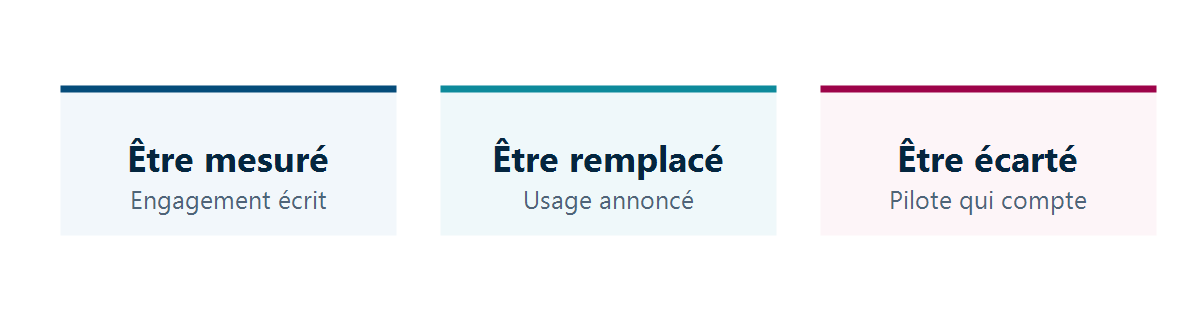
The fear of being judged
That’s the first question people ask in a meeting, and it’s a valid one. A tool that tracks submitted requests, active days, and the last date of use sounds a lot like a surveillance tool.
Microsoft has, in fact, addressed this issue in advance. The Administration Center’s readiness report, which identifies the employees most likely to benefit from a license, includes an explicit statement: this data is not intended to evaluate employee performance.
This statement is binding only on Microsoft. It is up to management to make the same commitment, put it in writing, and stick to it. A performance review that is used only once during an annual review permanently destroys trust, and no subsequent communication can restore it.
There is a second transparency issue to address at the same time. Users’ interactions with the assistant are stored in their Exchange Online inboxes. They are therefore subject to your retention policies and can be accessed by e-discovery tools, just like an email. While this is generally good news for compliance, it means you cannot tell teams that their conversations with the assistant are private. It’s best to make this clear from the start.
The fear of being replaced
It is rarely expressed directly, which makes it more difficult to address. It manifests itself as a polite and superficial acceptance: people try it twice, find it interesting, and then don’t come back to it.
Management cannot allay this fear by simply stating that AI will not replace anyone, because that statement does not entail any verifiable commitment. What works better is to specify exactly what the company will do with the freed-up capacity: which backlogged work will finally be addressed, which lead times will be shortened, and which tedious tasks will be eliminated. A concrete answer on this point is worth more than any general assurances.
If you don't have an answer to this question, your concerns are justified, and it's best to acknowledge this internally before beginning the rollout.
The fear of being fitted with a device without being consulted
It is implemented through the method rather than through discussion. Microsoft’s deployment guide identifies three phases: a pilot with a small group to test the system and gather feedback, a broader deployment, and then an operational phase focused on monitoring usage.
The key word is “feedback.” A pilot whose comments have no impact on the outcome stands out immediately, and has exactly the opposite effect of what was intended. If you commission a pilot, commit to changing at least one thing based on the feedback provided, and specify what that change is once the decision has been made.
What Microsoft Offers to Provide Support
User training is explicitly the customer’s responsibility, even for a solution that is fully managed by the vendor. Microsoft states this unequivocally in its service assurance documentation: training, configuring usage policies, and monitoring the results remain the customer’s responsibilities.
There are, however, two resources available, and they are underutilized.
Copilot Academy is a structured training program available at Viva Learning. It is enabled by default and accessible to all users Microsoft 365without requiring an additional license. An administrator can restrict access to only those with a Copilot license or make it available to everyone. License holders also receive a personalized monthly notification at Teams, which the organization can disable. The content is available in eight languages and can be duplicated and customized to the company’s line of business for organizations with a Viva license.
Microsoft 365 Copilot Chat is included with an Microsoft 365 . It does not have access to the organization’s content, making it a risk-free learning environment. It’s an inexpensive way to let teams get familiar with the process before any licenses are distributed.
Our Reading
The most common mistake is to treat retention as a communication issue, when in fact it is a matter of engagement.
A team doesn’t buy in just because something was explained to them clearly. It buys in because management made three verifiable commitments and kept them: performance reports will not be used to evaluate individuals, feedback from the pilot program will lead to change, and the capacity freed up will be used for the stated purpose. These commitments cost little to make but a great deal to break.
Our recommendation is to start with what costs nothing. Give all your employees access to Copilot Academy and let them use the included offering for six to eight weeks before purchasing any licenses. You’ll gain three things: a group of users who are already trained, a fairly clear idea of who is using it on their own initiative, and a purchasing decision based on observed usage rather than intuition.
There is one situation in which it’s better not to launch right now. If your organization is emerging from a reorganization, a cost-cutting initiative, or an IT project that was poorly received, the fear of being replaced will dominate everyone’s thoughts, no matter how well you communicate. Wait a few months, or start with a single team of volunteers whose results will speak for themselves.
One final point—and it’s not the most pleasant to hear. Senior management is often the worst place to start a rollout. Its members have little time to learn a new tool, their use of it remains superficial, and the example they set is one of superficial interest. It’s better to entrust the demonstration to people whose daily work is actually changing.
What to Do
- Draft the pledge not to conduct individual evaluations and distribute it before the rollout is announced.
- Make it clear that communications with the assistant are subject to the same retention policy as email.
- Before you begin, consider what will happen to the freed-up capacity.
- Make Copilot Academy available to everyone, without waiting to purchase licenses.
- Allow the teams to undergo training on the included offering for six to eight weeks.
- Commit to changing at least one aspect of the project following the pilot, and specify which one.
- Choose the people featured in the demonstration based on the reality of their work, not on their position.
None of this requires any special technical expertise, and most of it can be handled in-house. What’s most often missing is an outside perspective to identify when a deployment isn’t ready and to own that assessment in front of the business units. Lambert Consulting coordinates these commitments with the relevant departments before the announcement, on Microsoft 365 Copilot, and reminds us that almost all of the most common causes of failure can be addressed before the first license is issued. The use cases to be rolled out first are selected at the same time.
Microsoft Sources
What an article Can't Know
An article describes what applies to everyone. What varies from one organization to another is the inventory: which applications, which accounts, and which pieces of equipment are actually involved in your organization. The inventory determines the scope of the effort, and it cannot be summarized on a single page.
You'll be speaking directly with the engineers who will be doing the work, not with a middleman. We'll respond within 24 business hours.
Check what is still true
Announced dates are sometimes postponed, products are renamed, and conditions change. The blog tracks these topics over time: when a rule changes, a new post announces it.
Search for a topic in the blogIn the same issue
Three articles on the same topic. The blog has 149 articles, all of which are freely accessible.