


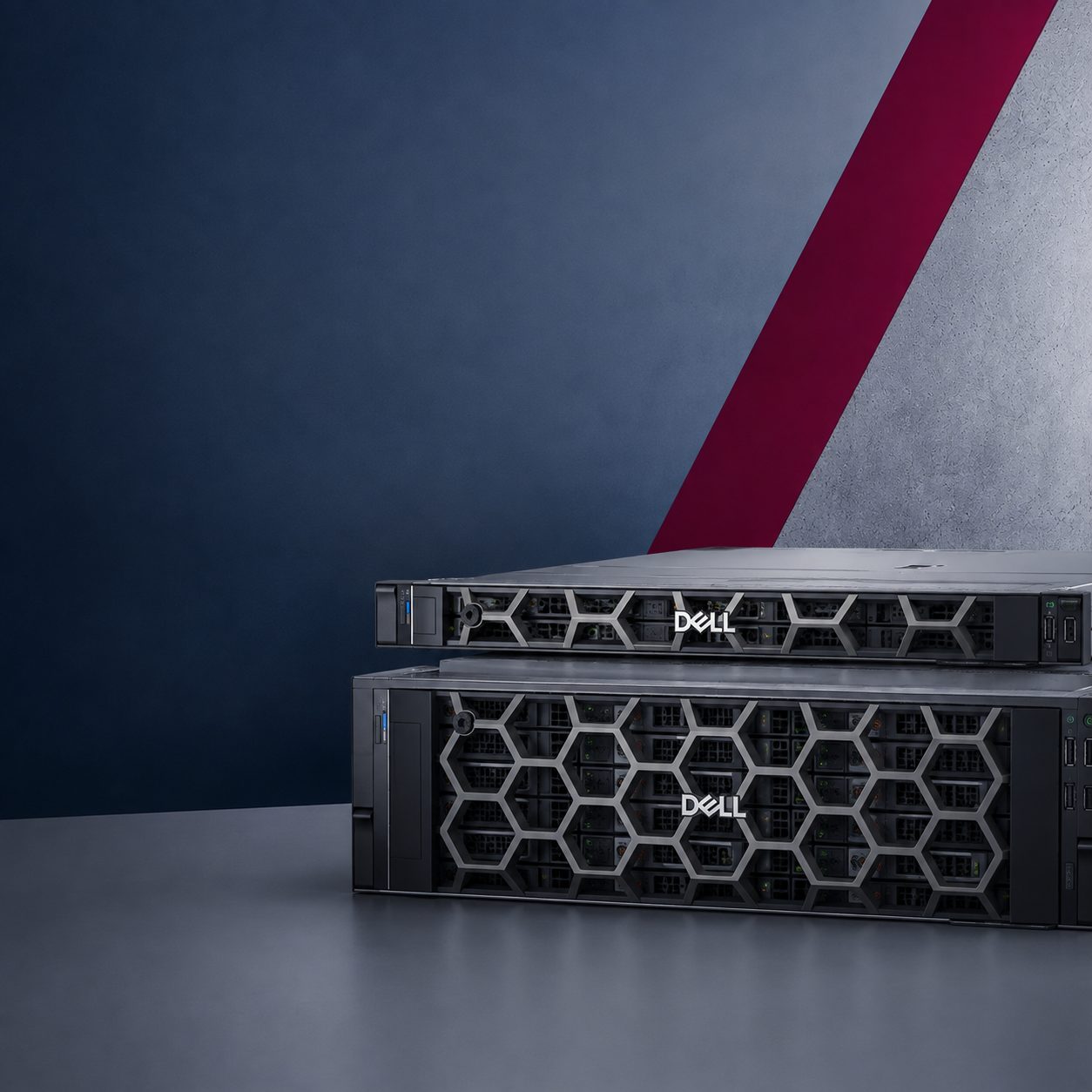
Equipment / Dell Technologies / Servers
A server sized for your applications, not for a catalog.
Without undersizing what's critical or oversizing the rest.You don't choose a server infrastructure simply by adding processors, memory, or capacity. It's designed to meet the needs of your applications, your data, your availability requirements, and your future plans. With Dell PowerEdge servers, we work with you to design this platform.
Three factors determine the sizing
The number of cores and the amount of memory come second. What determines the architecture is what the platform needs to support, for how long, and what happens when a component fails.
Your applications and your data
A transactional database, a virtualization platform, and an artificial intelligence environment do not place the same demands on resources. Disk access patterns, memory per virtual machine, and the need for accelerators should be assessed before selecting a model.
First, you measure; then, you configure.
Your availability requirements
The amount of time your business can operate without service determines the redundancy of power supplies, disks, and network cards—and, consequently, the number of servers required. This timeframe is a management decision, not a technical setting.
Availability is bought with actions, not intentions.
Your needs for the coming years
It should still be possible to add memory, hard drives, or an accelerator two years later without replacing the server. The chassis, available slots, and power supply should be selected on day one, when they cost almost nothing.
The reserve is set at the time of purchase.
Four product lines PowerEdge, four scenarios
The Dell PowerEdge product line caters to a wide range of needs, from on-premises infrastructure to high-density computing platforms. The form factor determines what you can do next: what fits inside the chassis, what can be added, and what the power supply can handle.
A server on your premises, without datacenter
Compact and scalable, for running your applications and services on-premises when there is no datacenter. It is often a company's first server—and the one that stays in service the longest.
A rack-mounted server, for centralization
A format that combines virtualization, databases, and business applications. It consolidates workloads onto fewer machines and takes up less space on the datacenter.
A server at your remote locations
Designed for branch offices, industrial sites, and distributed environments: rugged, space-saving, and remotely manageable when no one is on site to perform maintenance.
A server with graphics processors
Configurations featuring graphics processors and accelerators for inference, model training, advanced analytics, simulation, and high-performance computing.
A server designed to be managed
A server’s value isn’t determined solely by its performance. It depends on how it is deployed, monitored, updated, and secured throughout its entire lifecycle. This is the part that’s never factored into the initial purchase price—and that you end up paying for every month afterward.
iDRAC: Controlling Hardware Independently of the Operating System
The built-in controller provides access to the server's status, configuration, and console, regardless of the operating system installed. You no longer need to be in front of the machine to perform maintenance.
At a site without IT staff, it's the difference between a trip and a connection.
OpenManage Enterprise: A Console for All Your Servers
Inventory, equipment status, alerts, configurations, firmware, and compliance policies are all consolidated in one place. The benefits become apparent as soon as there are multiple servers, and they become crucial as soon as there are multiple sites.
Standardized configurations, and therefore comparable
Operations are becoming standardized and automated: fewer manual interventions, and, most importantly, fewer discrepancies between two servers that are supposed to be identical.
A consistent set can be diagnosed in a matter of minutes. A set that has drifted can be diagnosed in a day—and that is the day the service is shut down.
Secure startup and updates
PowerEdge 's cyber-resilient architecture protects hardware components and firmware, from system startup through update and maintenance operations.
These mechanisms are documented by Dell. We double-check them before each proposal, because the details change from one generation of servers to the next.
What you measure determines what you buy
Every change you make to your current environment limits your configuration options. Looking at them separately is the surest way to end up paying twice: once for the server, and once for what you had to add because a component was missing.
The reading direction matters: a measurement on the left closes out options on the right, but never the other way around. That is why the load survey comes before the estimate, and not the other way around.
What is your situation?
A server project almost always begins with one of these nine phrases. They don't lead to the same system specifications or the same budget —and recognizing which one applies to you is the key to success in the first meeting.
Your servers have become too old
You want better performance, a lower risk of downtime, and a platform tailored to what you’re doing today—not to what you were doing when you made your previous purchase.
Several servers are underutilized
Grouping them together simplifies operations, frees up resources, and reduces the amount of space they take up, power consumption, and the amount of cooling required.
Your virtualization platform is growing
VMware, whether it's Microsoft Hyper-V , or another platform: the architecture must maintain a balance among processors, memory, storage, and networking. If just one of these four components lags behind, it's enough to limit the other three.
You host mission-critical applications
ERP, databases, financial applications, or collaborative platforms: availability, consistent performance, and scalability are no longer negotiable once the system goes live.
You're running out of processing power
Simulation, data analysis, rendering, research, or scientific computing: these workloads behave differently from business applications and require different sizing.
You are implementing artificial intelligence
Training, inference, open-weight models, or accelerated analysis: the infrastructure is determined by graphics processors, memory, cooling, and connectivity—in that order.
You operate multiple locations
Branches, industrial sites, distributed infrastructure: these require compact, reliable systems that can be managed remotely without having to send someone on-site to restart them.
You simplify your operations
Standardize configurations, centralize administration, and streamline updates, maintenance, and support. This is a configuration goal, not just a purchasing one.
You expect growth
Your infrastructure must be able to scale without requiring a complete overhaul of the architecture with every new project. This is something you need to plan for when choosing your platform, before it becomes an issue.
The right server, not the most powerful one
Not all workloads have the same requirements. We analyze your usage patterns, constraints, and objectives to select and size the servers that are truly the right fit— which means making five trade-offs, and doing so right in front of you.
The relevant question is not “how many cores,” but “at what point does an additional core no longer make a difference in response time.” This threshold can be measured; it cannot be guessed.
A server that’s fully loaded on day one is the cheapest to purchase but the most expensive to scale. We provide cost estimates for both options, and you can make your choice once you know the difference.
Each level of redundancy adds another component—and another component to monitor. Beyond a certain point, the complexity causes more outages than it prevents.
Packing more into fewer rack units shifts the problem to power supply and heat dissipation. It’s the data center that decides, not the catalog.
An artificial intelligence platform doesn't replace your infrastructure—it's added alongside it, with its own power, cooling, and connectivity requirements. Combining them in the same chassis to save on a server is a decision that backfires the fastest.
How We Do It
A sizing study is not a quote. It is an engineering process that begins with measurements taken in your actual environment and ends with servers in production that are configured and documented.
Measuring the Existing Structure
Actual CPU and memory usage, disk access patterns, concurrent workloads, and available maintenance windows.
It is these figures—not the technical data sheets—that determine the configuration.
Sizing and Configuration
Family and model, number of cores, memory, disks, controller, network cards, accelerators, power supply, and cooling.
Each option is justified by a measurement from the previous step. Those that are not are removed from the estimate.
Prepare Before Delivery
Firmware updated, iDRAC settings configured, addressing set up, integration with OpenManage Enterprise, and the operating system and hypervisor installed.
The server arrives ready to handle your workloads. This is the step that sets a hardware vendor apart from a systems integrator.
Commission and document
Load balancing, redundancy checks on a per-component basis, and restoration testing when the backup comes online.
And documentation that can be used by a team other than ours: that’s the key to staying independent.
The scope is defined before we begin. This includes what we’ll handle, what you’ll retain, the option to reverse changes, and the clearly stated limits. The same engineers will support you from measurement through commissioning.
What Complements Your Infrastructure
A server rarely comes alone. Here are the six pages that go with it.
The data storage used by these servers
Block, file, and object; six platforms; and what those reduction rates actually mean.
View Storage NetworkThe network that connects these servers
There are four network levels, and the one removed from the estimate is the only one left once production has stopped.
View the network HyperconvergenceWhen computation and storage are handled within the same nodes
Four ecosystems, and the portion of the capacity allocation that is removed from the estimate is the portion that keeps the service running during an outage.
See Hyperconvergence Dell TechnologiesThe entire Dell product line, from computers to datacenter
Storage, networking, hyperconvergence, data protection, and preparing hardware for shipment.
View the entire collection Dell APEXThe same servers, paid for on a pay-as-you-go basis
Subscription and metered usage, and a fair comparison with a traditional purchase.
See Dell APEX Infrastructure and CloudWhat stays with you, what goes to Microsoft
The distinction between your own servers and external hosting, and the reasons for drawing the line in one place rather than another.
View the departmentThese same servers bring artificial intelligence to your premises. Whether it’s a private RAG for your confidential documents, a platform shared by multiple departments, or a private AI system, they are scaled based on the use case validated through prototyping—never based on a catalog.
Let's talk about your server infrastructure
Tell us about your applications, and we'll tell you what can be measured
What your business currently relies on, what you plan to add, and how long your business can go without the service. With these three elements, the first meeting is already productive.
What we offer is a meeting with the engineers who will do the work. The load analysis and sizing are part of the scope of work. The preliminary discussion, however, is free and is often enough to determine whether the project is feasible.
Renens, Sion, Châtel-Saint-Denis
Microsoft Gold Partner and a Gold Partner Dell Technologies. A single point of contact for sizing, ordering, preparation, and support.
Renens VD +41 21 806 37 15
Sion VS +41 27 552 00 22
Châtel-Saint-Denis FR +41 26 322 59 05