


AI as a Differentiator: What Can Be Copied and What Cannot
Two companies that deploy Microsoft 365 Copilot gain the same capabilities, often within the same week: that’s not where the competitive advantage lies. What really sets them apart, what that means for the investment, and what needs to be done.
A company that rolls out Microsoft 365 Copilot gains the same capabilities as its competitor doing the same thing—often within the same week. That’s the nature of a subscription service: it’s available everywhere, at the same price, with the same features.
This does not mean that no deviation is possible. It means that the deviation does not stem from the tool, and that a management team seeking a competitive advantage must know where to look for it.
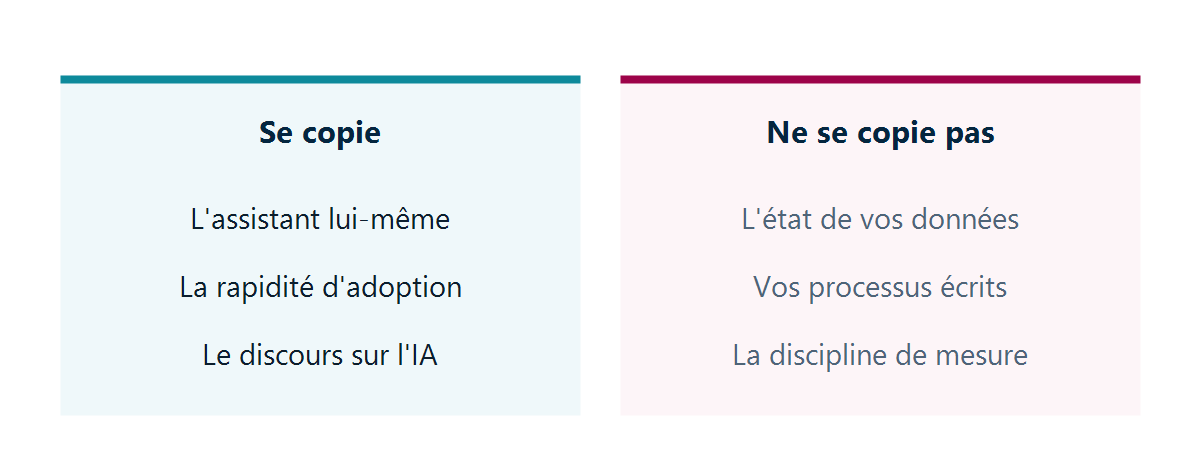
What doesn't make a difference
The assistant itself. Microsoft 365Copilot Chat is included with an Microsoft 365 . All your competitors who use Microsoft 365 have access to it, regardless of decision-making authority or budget. A benefit available to everyone isn't really a benefit.
Speed of adoption. Being ready six months ahead of a competitor provides a real—albeit short-lived—advantage, and no one builds a competitive position on that basis. It’s still a good reason to get started, but it’s not a strategy.
Talking about one's use of AI. The message has become so commonplace that it no longer tells the market anything.
What really sets it apart
Three things—and what they have in common is that they can’t be bought.
Your data—and the state it’s in. It’s the only asset your competitor can’t get their hands on. An assistant built on a well-organized, properly categorized, and up-to-date document repository produces answers that no other tool can provide. The same assistant applied to disorganized documents produces mediocre answers, and its deployment will have served only to reveal the state of the document collection. The difference in how two companies with identical equipment use the system comes down to this, above all else.
Your processes—and the fact that you’ve documented them. An agent built around a specific process—qualifying an incoming request, preparing a file, verifying an order—mirrors the way your company operates. This approach is the result of years of refinement, and it cannot be replicated simply by observing your site. This is also why the value lies in the agents themselves rather than in a generic assistant.
The discipline of measurement. An organization that understands the results of its practices can reorient its investments more quickly than one that operates on intuition alone. This is a cumulative, subtle advantage that is particularly difficult to overcome.
What This Means for Investing
The budgetary implication is clear and often counterintuitive: the most profitable part of the investment does not go toward licenses. It goes toward organizing data, documenting processes, and building agents based on those processes.
The corresponding tools are available within the Microsoft ecosystem, with their own pricing structure. Copilot Studio allows you to build these agents, which are billed using credits separate from licenses. Microsoft Agent 365 adds a management plan to govern them when the number of agents warrants it, at $15 per user per month, or as part of Microsoft 365 E7 at $99.
The key point to remember when making a decision: Licenses are easily comparable across competitors, whereas the value generated depends on internal work that no one else can do in their place.
Our Reading
We advocate for a more modest goal than the one typically discussed in this context.
For most medium-sized companies, seeking a competitive advantage through AI is the wrong way to frame the goal. What’s actually achievable is doing two or three things you were already doing—but doing them better, faster, and at no extra cost. That won’t make the news, but it will improve the bottom line.
Our recommendation is to abandon the AI strategy in the broad sense and instead focus on two processes. Two well-documented, measurable, well-resourced, and closely monitored processes yield better results than a three-year transformation program whose impact no one can really pinpoint.
It’s also important to consider a scenario in which AI will make no difference, no matter what resources are deployed. If your competitive advantage rests on long-term customer relationships, your teams’ rare expertise, or your geographic location, AI will improve your internal operations without affecting what gives you your competitive edge. In this case, investing is justified for the sake of efficiency, not for the sake of differentiation. Confusing the two leads to overinvestment and the expectation of results that will never materialize.
Finally, a note on the timeline. Data cleansing is the only one of these three initiatives whose value does not depend on AI: it supports compliance, audits, employee departures, and incident response. It is therefore the one to start with, even for an organization that is still undecided about the next steps.
What to Do
- Check out what your competitors are already doing without making any decisions. This helps you identify what won't set you apart.
- Choose two processes, document them, and evaluate them before beginning any construction work.
- Treat the organization of your document collection as a standalone project—one that is valuable even without an AI project.
- Invest in agents built around your processes rather than in expanding your license portfolio.
- In your committee presentation, distinguish between what improves efficiency and what builds a position. Both are defensible—separately.
- Implement metrics from the very first project. That’s the advantage that takes competitors the longest to catch up to.
The technical design of the agents is the most well-understood part of this system. What determines the outcome is the choice of processes and the state of the data repository on which they rely. Lambert Consulting addresses these two points before building anything on Copilot Studio, based on an inventory of candidate processes and an analysis of the actual expense categories involved. The issue of agent governance arises as soon as their number increases.
Microsoft Sources
What an article Can't Know
An article describes what applies to everyone. What varies from one organization to another is the inventory: which applications, which accounts, and which pieces of equipment are actually involved in your organization. The inventory determines the scope of the effort, and it cannot be summarized on a single page.
You'll be speaking directly with the engineers who will be doing the work, not with a middleman. We'll respond within 24 business hours.
Check what is still true
Announced dates are sometimes postponed, products are renamed, and conditions change. The blog tracks these topics over time: when a rule changes, a new post announces it.
Search for a topic in the blogIn the same issue
Three articles on the same topic. The blog has 149 articles, all of which are freely accessible.